Why FOB Price Comparisons Are Costing You Money
Every procurement manager knows how to compare two quotes side by side. Supplier A offers a dining set at $220 FOB. Supplier B quotes $265. Supplier A wins. The order is placed. Twelve months later, cushion foam has collapsed on 15% of chairs. Three years in, rust spots appear on frame joints. At year five, the entire set needs replacement — and the true cost of that "$220 bargain" is closer to $410 per unit when maintenance, partial replacement, and re-shipping are included.
This is not a hypothetical scenario. It is the standard outcome when procurement decisions are made on FOB price alone. The purchasing team that understands TCO — total cost of ownership — consistently makes better long-term decisions than the team chasing the lowest line-item price. This guide shows you exactly how to calculate TCO for commercial outdoor furniture, with real numbers you can plug into your own spreadsheets.
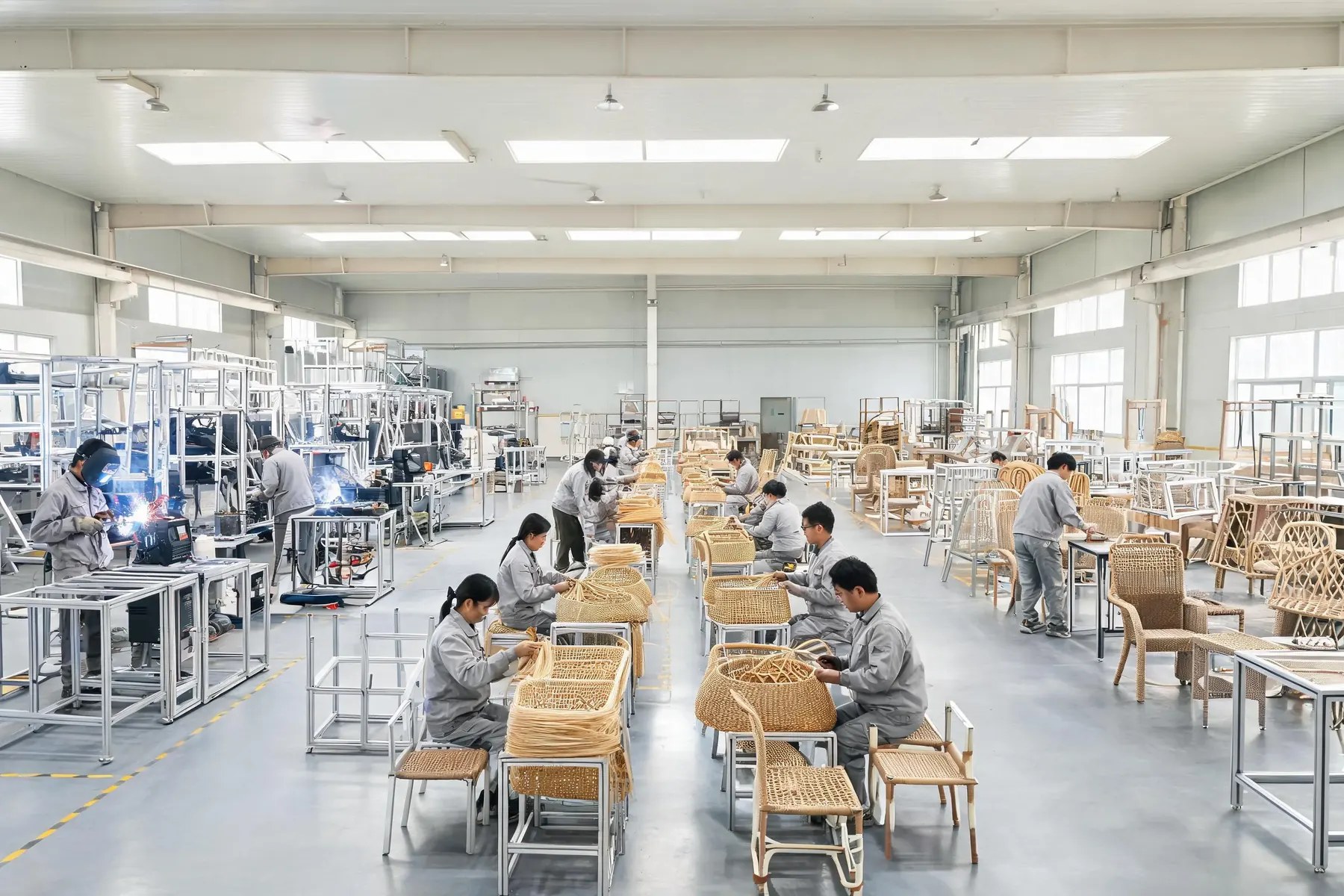
We have written this from the perspective of a factory that has shipped to hotels, resorts, and restaurant chains across 30+ countries. Every number in the tables below comes from actual orders processed at our 16,000 m² Shunde manufacturing facility.
The TCO Formula: What Actually Goes Into the Number
Start with the simplest possible framework. TCO has five components, and only one of them appears on a supplier's quotation:
- Purchase Cost — FOB price × quantity. This is the quote you see.
- Logistics Cost — Ocean freight, insurance, import duties, customs brokerage, port handling, inland trucking to your facility. Typically 18-35% of FOB depending on destination and container utilization.
- Maintenance Cost — Labor hours × hourly rate, plus cleaning supplies and consumables. Annual cost that compounds every year the furniture is in service.
- Replacement Cost — Components that wear faster than the frame (cushions, sling fabric, glass table tops). Plus the cost of ordering, shipping, and installing replacements.
- Downtime Cost — Revenue lost when furniture is out of service. A pool lounger that sits broken for two weeks during peak season costs more in lost F&B revenue than the lounger itself.
The TCO formula: TCO = Purchase + Logistics + (Annual Maintenance × Years) + Replacement Parts + Downtime. For a detailed breakdown of logistics costs specifically, see our export logistics guide.
Case Study: $25K FOB Order — What It Actually Costs Over 5 Years
Let us walk through a realistic 100-piece dining set order for a mid-market resort. Each set includes one table and four chairs. FOB price: $250/set. Total purchase: $25,000.
| Cost Category | Year 1 | Year 2 | Year 3 | Year 4 | Year 5 | 5-Year Total |
|---|---|---|---|---|---|---|
| Purchase (FOB) | $25,000 | $0 | $0 | $0 | $0 | $25,000 |
| Shipping & Duties | $7,200 | $0 | $0 | $0 | $0 | $7,200 |
| Annual Maintenance | $800 | $800 | $900 | $1,100 | $1,200 | $4,800 |
| Cushion Replacement | $0 | $0 | $4,500 | $0 | $0 | $4,500 |
| Frame Repair / Replace | $0 | $0 | $600 | $800 | $1,200 | $2,600 |
| Annual Total | $33,000 | $800 | $6,000 | $1,900 | $2,400 | $44,100 |
The TCO per set is $441 — nearly double the $250 FOB price. And this assumes moderate maintenance and only one cushion replacement cycle. For properties in coastal or high-UV environments, maintenance and replacement costs escalate faster. Our UV-resistant materials guide explains how material choice directly impacts these numbers.
How Material Quality Affects TCO: Three Scenarios Compared
Not all $250 dining sets are created equal. The single biggest variable in outdoor furniture TCO is material grade. Below we compare three sourcing strategies for the same 100-piece order over 5 years.
| TCO Factor | Big-Box Retail | Trading Company | Factory Direct (SOLAIREVA) |
|---|---|---|---|
| Frame material | 1.2mm steel tube | 1.5mm 6061 aluminum | 1.8mm 6063-T5 aluminum |
| Powder coat | 60μm single-layer | 80μm dual-layer | 120μm triple-layer |
| FOB per set | $180 | $250 | $280 |
| FOB total (100 sets) | $18,000 | $25,000 | $28,000 |
| Year 3 rust/repair | $4,200 | $1,800 | $400 |
| Cushion replacement | Year 2 + Year 4 | Year 3 | Year 4 only |
| Total 5-year TCO | $42,600 | $44,100 | $39,200 |
| TCO per set | $426 | $441 | $392 |
The counterintuitive result: the highest FOB price produces the lowest 5-year TCO. The big-box set starts cheap but incurs $24,600 in downstream costs — more than its purchase price. The factory-direct set costs $10,000 more upfront but saves $3,400-$4,900 in total ownership cost over five years. This is the TCO argument in one table. For a deeper dive into material grade's impact on durability, read our PE rattan vs aluminum comparison.
Shipping Efficiency: The Hidden 10-15% TCO Lever
Most buyers treat shipping as a fixed cost — you pay what the freight forwarder quotes. But container loading efficiency can swing logistics cost by 10-15% per unit, which on a $30,000 total logistics bill is a $3,000-$4,500 difference. That is real money.
Here is what optimal vs average container loading looks like for a standard 40HQ container:
| Product Type | Average Loading (pieces) | Optimized Loading (pieces) | Freight per Unit (avg) | Freight per Unit (optimized) | Savings per Unit |
|---|---|---|---|---|---|
| Dining chairs (stackable) | 220 | 260 | $27.27 | $23.08 | $4.19 |
| Dining tables (KD) | 90 | 105 | $66.67 | $57.14 | $9.53 |
| Sun loungers | 120 | 140 | $50.00 | $42.86 | $7.14 |
| Sofa sets (3-pc) | 42 | 50 | $142.86 | $120.00 | $22.86 |
On a mixed container with 200+ pieces, optimized loading easily saves $1,000-$2,000 in freight. Multiply that across multiple containers per year and the TCO impact is substantial. Our container loading calculator lets you estimate exact per-piece freight costs for your specific product mix. See also our container loading guide for space optimization techniques.
Maintenance: The Compounding Cost Most Buyers Underestimate
Maintenance is the silent budget killer in outdoor furniture TCO. A property with 200 pieces of outdoor furniture typically spends $1,600-$3,000 per year on maintenance labor and supplies — and that number compounds every year. Over a 5-year cycle, maintenance alone can equal 10-20% of the original purchase price.
PE rattan furniture requires quarterly deep cleaning (brush between weave strands, degreaser for sunscreen residue) plus annual weave tension checks. Budget roughly $15-30 per piece per year for a property with dedicated maintenance staff.
Powder-coated aluminum requires monthly washing with mild detergent and periodic touch-up of scratches to prevent corrosion points. Budget $5-10 per piece per year — roughly one-third the maintenance cost of rattan.
Teak wood requires the most intensive maintenance: annual pressure washing, bi-annual oiling, and potential sanding of weathered gray surfaces if the property wants to maintain the honey-brown appearance. Budget $20-40 per piece per year.
The maintenance cost difference between aluminum and teak over 5 years for 200 pieces: approximately $15,000-$30,000. That alone can justify a complete material strategy shift. Read our maintenance checklist for a detailed cleaning schedule by material type.
When TCO Analysis Changes Your Buying Decision
Here are the specific scenarios where running a TCO calculation before ordering will change what you buy:
Scenario 1: Coastal Property Within 500m of Salt Water
A hotel procurement team compares PE rattan dining sets ($220 FOB) vs marine-grade aluminum sets ($310 FOB). The $90/unit premium seems steep — but salt spray exposure means the rattan weave degrades in 4-5 years and the set needs full replacement at year 6. The aluminum set lasts 15+ years in the same environment. TCO over 10 years: rattan = $540/set (original + replacement + maintenance); aluminum = $410/set. The "expensive" option saves $130 per unit.
Scenario 2: High-Turnover Restaurant Patio
A restaurant chain needs 80 dining sets for year-round outdoor service. The operations team wants stackable aluminum chairs ($85/chair) for easy cleaning; the design team prefers teak armchairs ($140/chair) for aesthetic warmth. TCO analysis reveals the teak option costs an additional $22,000 in maintenance over 5 years. The chain chooses aluminum for TCO reasons but adds custom powder-coated wood-grain finish to satisfy the design brief — a compromise that the restaurant's OEM customization capability made possible.
Scenario 3: Resort Opening — Cash Flow vs TCO
A new resort has a tight opening budget. The GM wants to spend $150,000 on furniture. TCO analysis shows that spending $180,000 now (20% more) on high-grade materials reduces 5-year TCO from $270,000 to $225,000 — a $45,000 net saving. The GM takes the TCO data to investors and secures the additional $30,000 capital allocation. This is how TCO analysis becomes a procurement tool, not just a finance exercise.
Build Your Own TCO Spreadsheet: The 12 Variables
Here is every variable you need to model TCO for your specific project. Copy these into a spreadsheet and populate with supplier-provided data:
- FOB price per unit — from supplier quotation
- Quantity — total pieces by product type
- Container size and quantity — 20ft, 40ft, or 40HQ
- Ocean freight rate — current market rate to your port
- Import duty rate — HS code dependent, typically 0-8% for furniture
- Inland trucking cost — port to warehouse distance
- Annual maintenance labor hours — per piece × hourly rate
- Annual consumables cost — cleaning supplies, replacement hardware
- Cushion lifespan — years before foam/fabric needs replacement
- Frame warranty period — what the supplier guarantees and for how long
- Expected furniture lifespan — conservative estimate based on material and climate
- Discount rate — if modeling NPV for capital budgeting
For specific material lifespan data by climate zone, refer to our complete materials guide. For warranty comparisons across suppliers, see our warranty comparison guide.
Factory-Direct Sourcing: The Structural TCO Advantage
There is a structural reason factory-direct sourcing consistently produces lower TCO: removing the trading company middleman eliminates a 15-25% markup without reducing material quality. When you buy from the manufacturer, the price difference goes into better materials (thicker aluminum, higher-density foam, UV-stabilized PE) rather than a middleman's margin.
This is the fundamental insight behind every TCO comparison table in this guide: the factory-direct option does not win because the FOB price is lower (it is often slightly higher). It wins because the $30-40/set premium buys aluminum grade and powder coat thickness that eliminate $80-120/set in downstream maintenance, repair, and early replacement costs.
The buyers who understand this are the ones who send a factory verification team to Shunde, walk the production line, and see the 6063-T5 raw material stock with their own eyes. They calculate TCO before signing the PO — and they almost never go back to trading company sourcing afterward.
Get a TCO estimate for your specific project
Every property has a unique cost structure — different shipping lanes, duty rates, maintenance labor costs, and climate conditions. Our project team can model a 5-year TCO estimate for your specific furniture requirements, comparing material options and container configurations to identify the lowest total ownership cost for your scenario.
Provide your project details — product types, quantities, delivery port, and climate conditions — and we will return a quantified TCO comparison within 2 business days. No obligation, no sales pressure. Just the numbers you need to make an informed procurement decision.
Frequently Asked Questions
What is total cost of ownership (TCO) for outdoor furniture?
TCO is the sum of all costs over a furniture set's useful life: upfront purchase price (FOB or CIF), shipping and customs, ongoing maintenance labor and supplies, replacement of worn components, and the cost of downtime when furniture is out of service. A $20,000 FOB order can easily become $35,000-$45,000 in TCO over 5 years once these hidden costs are included.
Why do FOB price comparisons alone give the wrong picture?
FOB only covers the product leaving the factory gate. It excludes ocean freight, insurance, import duties, port handling, inland trucking, maintenance labor, replacement cycles, and downtime costs. Two suppliers with identical FOB prices can have 30-50% different 5-year TCO depending on packaging quality, material durability, and after-sales support.
How much does shipping add to the total cost of outdoor furniture?
Shipping and logistics typically add 18-35% to the FOB price depending on destination and container utilization. A 40HQ container from China to the US East Coast costs approximately $4,500-$6,500 in 2026, which adds roughly $22-32 per dining set when the container is optimally loaded. Inefficient loading can push that to $45+ per piece.
What is the typical 5-year TCO for a 100-piece commercial order?
For a typical 100-piece dining set order from China (FOB $25,000), the 5-year TCO typically runs $38,000-$52,000 once shipping, duties, maintenance, cushion replacement, and 5-10% replacement furniture are included. Factory-direct sourcing can reduce 5-year TCO by 15-25% compared to trading company or big-box retail sourcing.
Does buying cheaper outdoor furniture save money in the long run?
Rarely. A $150 chair replaced every 3 years costs $250 over 6 years, plus two rounds of shipping and disposal. A $220 chair from a factory using 6063-T5 aluminum and UV-stabilized PE rattan typically lasts 8-12 years with one cushion replacement — total 6-year cost around $270 but with zero disposal and re-procurement labor. The upfront savings disappear quickly when replacement cycles and maintenance are factored in.