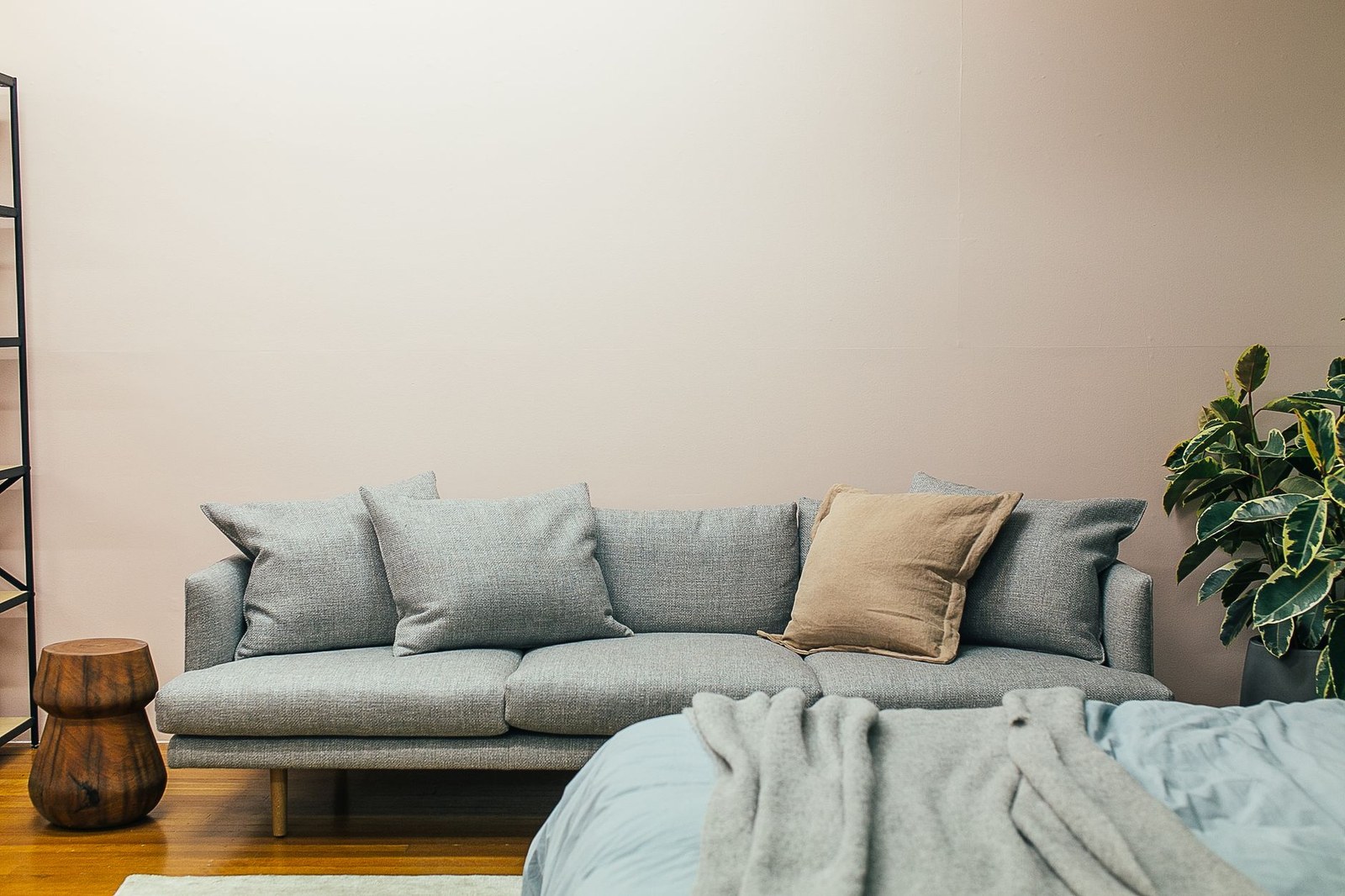
What an outdoor furniture fabric and cushion order specifies
A cushion order is specified by fabric weight, dye method, foam density and tested UV hours. Contract seating in 2026 runs 240 to 320 g/m2 solution-dyed acrylic, 28 to 35 kg/m3 foam and 1,000 to 1,500 UV hours under ISO 105-B02 or AATCC 16E. Retail cushions sit at 160 to 220 g/m2, 18 to 22 kg/m3 foam and no stated UV result. On a restaurant terrace the retail spec fails within two summers: the foam flattens first, then the covers fade in patches where the sun tracks across the terrace through the afternoon.
Frames get most of the attention in a first enquiry. Fabric and foam decide how the furniture looks and feels in year three, and they are the parts a buyer cannot repair on site. A frame that loses powder coat at a joint can be touched up by a maintenance team. A cushion that has gone flat and pale cannot be rescued at any sensible cost.
The table below is the cushion spec sheet we work through on a first enquiry, with the retail default next to the contract requirement.
| Specification line | Retail default | Contract requirement |
|---|---|---|
| Fabric weight | 160-220 g/m2 | 240-320 g/m2 |
| Dye method | Surface-dyed or printed | Solution-dyed, colour through the fibre |
| Lightfastness | Not stated | Grade 4 minimum, grade 6-7 at 1,000 hours |
| Foam | 18-22 kg/m3 standard PU | 28-35 kg/m3 high-resilience or quick-dry |
| Cushion thickness | 80-100 mm seat | 100-150 mm seat, 100-120 mm back |
| Cover | Stapled, fixed | Removable, UV-stable zip, double-stitched |
| Fire treatment | None | BS 5852 crib 5 or CAL TB 117-2013 where required |
| Fabric warranty | None or 1 year | 2-5 years with a stated fade allowance |
Solution-dyed acrylic, olefin, polyester and textilene
Solution-dyed acrylic at 240 to 320 g/m2 holds lightfastness grade 6 to 7 after 1,000 hours of ISO 105-B02 testing and lasts five to eight summers in strong sun. It costs 40 to 70 percent more than polyester at the same fabric weight. Olefin reaches grade 5 to 6 with 500+ UV hours and sits 20 to 35 percent above polyester on price. Standard polyester at 180 to 250 g/m2 holds grade 4 to 5 and shows visible fade within two to three summers in Dubai, Florida or Queensland conditions.
Solution-dyed means the pigment enters the fibre before extrusion, so the colour runs through the yarn. Surface-dyed and printed fabric keeps its colour in a thin layer, and that layer is what sunlight, chlorine and cleaning wear through. You can see the difference on a five-year-old hotel cushion: solution-dyed fabric fades evenly and slowly, while printed fabric develops pale fold lines and a chalky surface where the print has worn.
Textilene is a different product in the same catalogue. It is PVC-coated polyester mesh at 550 g/m2, rated 1,000+ UV hours, and it is used as a sling seat where no cushion is wanted: pool decks, beach clubs, restaurant terraces that get hosed down at close of business. Lighter mesh at 400 g/m2 sags within 12 to 18 months under commercial load, so the weight is the number to check.
| Fabric | Weight | Lightfastness (ISO 105-B02) | Service life | Price effect |
|---|---|---|---|---|
| Polyester, surface dyed | 180-220 g/m2 | Grade 4 to 5 | 2-3 summers in high UV | Base |
| Polyester, PU coated | 200-250 g/m2 | Grade 4 to 5 | 2-4 summers | +10-20% |
| Olefin | 200-240 g/m2 | Grade 5 to 6 | 3-5 summers | +20-35% |
| Solution-dyed acrylic | 240-320 g/m2 | Grade 6 to 7 at 1,000 hours | 5-8 summers | +40-70% |
| Textilene mesh (sling) | 550 g/m2 | 1,000+ UV hours | 5+ years, no cushion | Per m2, no foam |
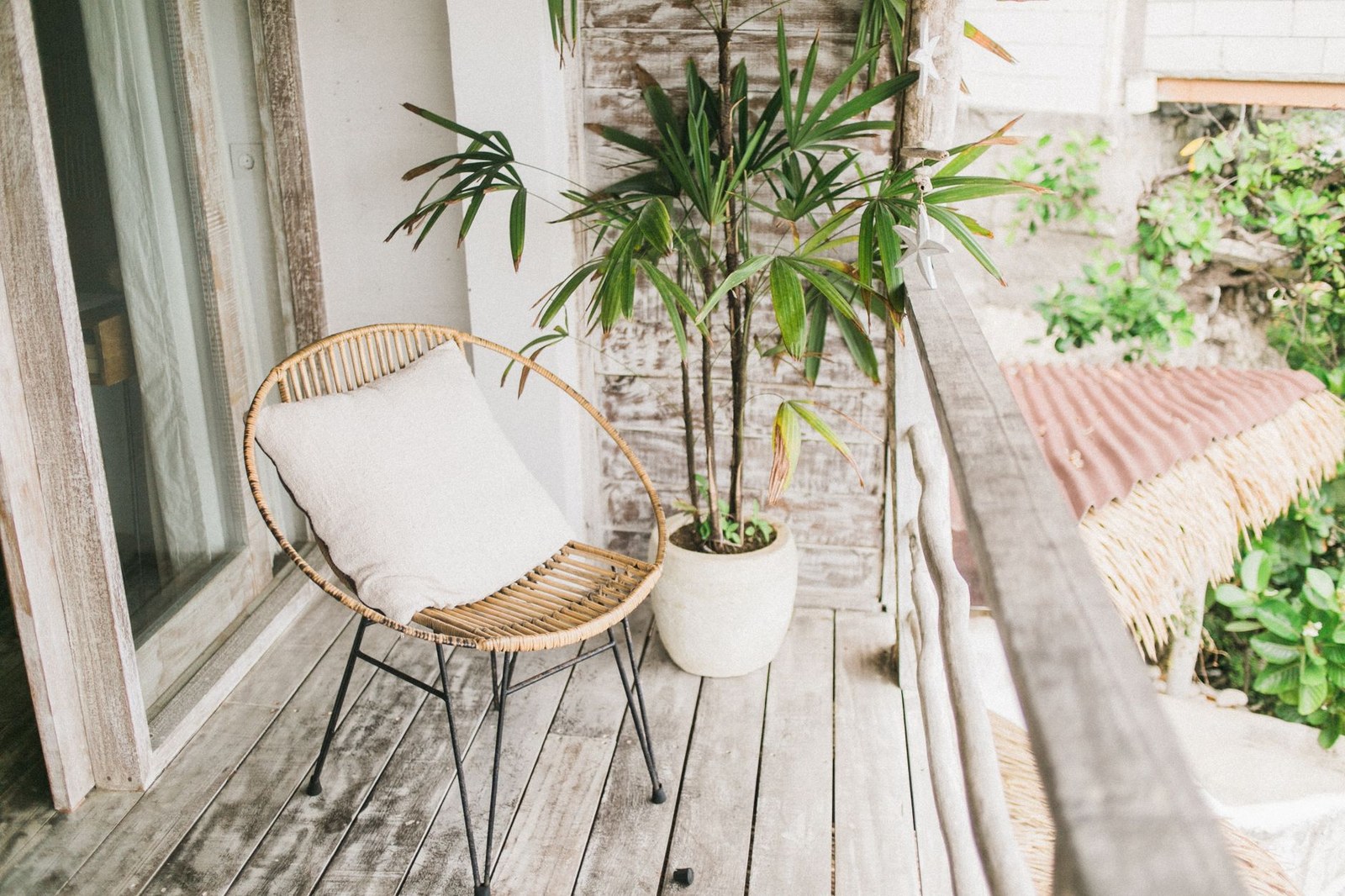
Fabric weight and Martindale rubs answer different questions
Fabric weight controls how a cover hangs, how much light it blocks and how it holds shape at the seams. Martindale rubs control how the surface wears against clothing, zips and frame edges. Contract upholstery needs 25,000 rubs to ISO 12947 as a floor and 30,000 to 40,000 for hotel lobbies and public areas. A 180 g/m2 cover at 15,000 rubs is a garden cushion. A 280 g/m2 cover at 35,000 rubs is seating that survives five seasons of daily restaurant use.
Both numbers can be verified without a laboratory visit. Cut a 10 x 10 cm sample from the roll and weigh it: at 280 g/m2 the sample should read 2.8 g within 5 percent. For abrasion, ask for the ISO 12947-2 report and read the end point, which is fibre breakdown rather than colour change. A supplier who sends a grade without the report is asking you to trust a marketing line.
Duty cycle decides how much fabric you actually need. A villa terrace used at weekends can live with 200 g/m2 olefin. A pool deck that sees 300 guests a day, chlorinated water and a hose-down every evening needs the heavier cover, quick-dry foam and a drainage path through the seat platform. Our UV resistant materials guide covers the same trade-off across frames, straps and fabrics.
| Application | Fabric weight | Martindale (ISO 12947) | Foam |
|---|---|---|---|
| Home terrace, weekend use | 180-220 g/m2 olefin or polyester | 15,000-20,000 | 22-28 kg/m3 |
| Restaurant terrace, daily service | 240-300 g/m2 solution-dyed acrylic | 25,000-30,000 | 28-32 kg/m3 |
| Hotel lobby and lounge | 280-320 g/m2 solution-dyed acrylic | 30,000-40,000 | 30-35 kg/m3 |
| Pool deck and beach club | 280-320 g/m2 acrylic or 550 g/m2 textilene | 25,000+ | 30-35 kg/m3 quick-dry |
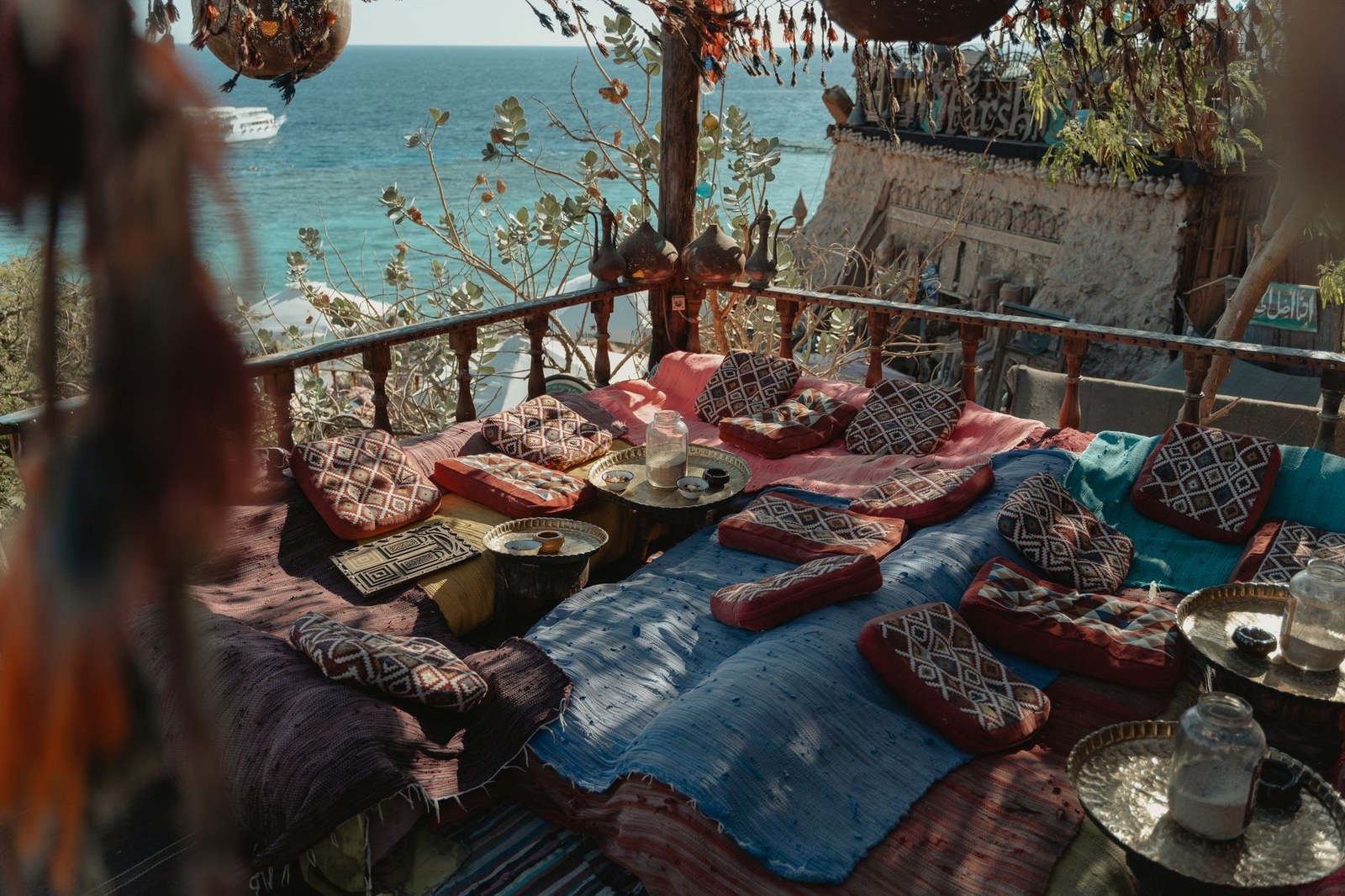
Water repellent, water resistant and waterproof are three different claims
A new outdoor cover with a repellent finish scores 80 or higher on the AATCC 22 spray test; after five washes, 70 is the usual contract floor. Water resistant covers hold off a shower for 20 to 40 minutes. Waterproof is a construction claim that needs a coated back, taped seams and a drainage path, and a loose cushion has none of those. A sealed cushion traps water inside and grows mildew within two to three weeks in a warm climate.
What actually keeps a pool cushion usable is drainage. Quick-dry foam has open cells that let water pass through, and a mesh under-panel lets it leave the cover. Water that sits between cover and foam starts to smell within a season, and no amount of cleaning gets the smell out of closed-cell foam. This is why a pool deck order should never use the same foam as a shaded lounge.
Test the claim on the sample, not on the brochure. Pour 50 ml of water on the cover and time how long the bead sits before it wicks into the weave; then look at the seam and the zip tape, which is where water enters first. For pool and coastal projects, ask about chlorine and sunscreen resistance as well, because both attack the finish faster than sun alone. The pool sun lounger guide covers the frame and sling side of the same specification.
UV hours and colour fastness decide year three
Ask for a lightfastness result as a grade plus the test hours behind it. Grade 4 is the minimum for outdoor use in most markets, and grade 6 to 7 after 1,000 hours is what solution-dyed acrylic delivers. The method matters as much as the number: ISO 105-B02 uses a xenon arc, AATCC 16E reports on a different scale, and a "1,500 hour" claim with no method and no laboratory on the report is a marketing sentence.
Contract projects should state a fade allowance in the purchase order, for example no more than grade 4 change at 1,500 hours. Most fabric warranties exclude normal colour change under UV, which is the exact failure a terrace sees first. A written allowance turns a vague exclusion into something a buyer can hold a supplier to in year three, when the first replacements are being argued about.
Dye lots matter for anything larger than one seating group. A 200-cushion hotel order should come from one dye lot, and a second phase ordered a year later needs a lab dip against the retained swatch. Matching the cushion to the frame powder coat is a separate step with its own tolerances; our custom colour matching guide explains how RAL, Pantone and fabric dye lots are handled together.
Foam density and the 18 kg/m3 problem
Contract seat cushions need 28 to 35 kg/m3 high-resilience polyurethane foam. Foam at 18 to 22 kg/m3, standard in retail sets, compresses visibly within 6 to 12 months of daily commercial use and never recovers its shape. Quick-dry reticulated foam at 30 to 35 kg/m3 drains water through open cells and suits pool decks. Closed-cell foam at 35 kg/m3 resists chlorine but feels firm, so it works on sun loungers rather than lounge sofas.
Density alone does not tell you how a cushion feels. Ask for the hardness figure (ILD or compression load) next to the density, because a 30 kg/m3 foam can be produced soft or firm and both will pass a density check. A polyester fibre wrap over the foam adds shape, softens the edges and hides the cut line; it also adds a small amount of water retention, which is why pool cushions often skip it.
On the receiving dock, a foam problem shows up as a compressed front edge and a seat that bottoms out under a 90 kg guest. We cut a sample from the first production batch and keep it with the golden sample, so a later complaint can be checked against the foam that was approved rather than against a memory of it.
| Foam type | Density | Where it belongs | Expected life under daily use |
|---|---|---|---|
| Standard PU | 18-22 kg/m3 | Retail sets, occasional use | 6-12 months before visible compression |
| High-resilience PU | 28-32 kg/m3 | Restaurant and hotel seating | 3-5 years |
| Quick-dry reticulated | 30-35 kg/m3 | Pool deck, beach club | 3-5 years, drains in minutes |
| Closed-cell PE or EVA | 35 kg/m3 | Sun lounger mats, chlorine exposure | 5+ years, firm feel |
Cover construction: zips, piping, thread and seams
A contract cushion cover is removable, closed with a UV-stable coil zip, double-stitched along the front edge and finished with 8 to 12 mm piping. Seat cushions run 100 to 150 mm thick and back cushions 100 to 120 mm. Stapled covers and single-stitched seams are where cheap cushions fail: the front edge takes the rub from legs, and the zip tape takes the pull every time housekeeping removes a cover for cleaning.
Thread has to survive the same sun as the fabric. Bonded polyester thread is common and fades before the cover does; solution-dyed acrylic or PTFE thread costs more and holds its strength for the life of the cushion. Check the bar-tacks at the corners and at the tie points, because a cushion that tears at the tie has usually lost the reinforcement before it lost the fabric.
Every stitch is a needle hole, which is why a repellent finish and a waterproof claim can coexist on paper and fail in a rainstorm. Market labels belong in the same conversation: UK contract seating is normally specified to BS 5852 crib 5, US cushions to CAL TB 117-2013, and covers for either market can carry OEKO-TEX Standard 100 certification. A fire-retardant treatment adds USD 6 to 12 per cushion and slightly reduces the fabric's softness.
Four checks that catch a bad cushion before it ships
Weigh, pull, measure and compare. A 10 x 10 cm sample from the production roll must match the approved fabric weight within 5 percent, seam strength is tested to ISO 13935-2 and reported in newtons per 50 mm, foam density is checked against the supplier sheet with a cut sample, and colour is measured against the approved lab dip with a spectrophotometer, where a reading above 1.5 delta E is a reject on a contract order.
These checks happen at four points on our line: incoming fabric and foam, cutting, sewing, and final packing. The export defect rate across those stages runs at 0.47 percent, and most of what we catch is stitching and measurement, not material failure. Catching a 3 mm size error before packing is cheap; catching it after the container lands in Rotterdam is a claim, a replacement run and a customer who never orders again.
Retain a golden sample. Ours is a signed cushion from the approved pre-production run, kept with the fabric and foam batch references, and it is the reference for every later order on the same design. When a buyer changes factory or adds a second supplier, that sample is the only objective standard either side has.
How to specify a cushion order in five steps
Specify from the venue inward. Five steps produce the documents a factory needs to quote accurately, and each one removes a question that would otherwise come back as an assumption. Buyers who stop after step four get a bulk order that matches the purchase order and not the photograph they thought they approved.
- Define the venue and duty cycle. Record hours of daily use, sun exposure, whether cushions stay out overnight, and how they are cleaned. A pool deck hosed down every evening needs different foam from a shaded villa lounge.
- Set fabric chemistry and weight. Choose solution-dyed acrylic, olefin, coated polyester or textilene mesh, then fix the weight in g/m2 and the lightfastness grade you will accept.
- Set foam density and drainage. Pick 28 to 35 kg/m3 high-resilience for seating, quick-dry reticulated for wet areas, and state the thickness for seat and back separately.
- Write the construction sheet. Cover removability, zip type, piping size, thread, seam treatment, tie or Velcro fixing, labels and fire treatment all belong in one page the factory signs.
- Approve a lab dip and a pre-production sample, then lock the golden sample. Measure thickness, weigh the fabric, and test the zip before signing anything.
MOQ, sampling and lead times for custom cushions
MOQ on cushions is 20 to 30 sets per design in an existing fabric colour, 30 to 50 when the colour, foam or size is new, and 100 to 200 when the mill dyes fabric to a Pantone reference. Samples take 10 to 15 days from stock fabric and 20 to 30 days with a custom dye lot. Bulk production runs 25 to 40 days after deposit, longer from August to October when European and North American programmes load the lines.
Cushions rarely reach a sensible MOQ on their own because they are light and carry little value per cubic metre. The usual route is to place them with the frame order, where 40 chairs and 20 sofa sets already clear the minimum, and to use stock fabric for the first delivery while a custom colour runs for phase two.
Judge a sample after it has recovered. Vacuum-packed cushions arrive thin and creased, and they need 24 to 48 hours out of the bag before the thickness is real. Measure at the centre and at the front edge, sit on it for an hour, then decide. A sample judged straight out of the carton gets rejected for a problem that does not exist.
FOB prices for outdoor cushions in 2026
A three-seat cushion set in olefin runs USD 35 to 65 FOB, the same set in 280 g/m2 solution-dyed acrylic runs USD 60 to 110, and quick-dry foam adds USD 8 to 18 per seat. Contract fabric adds USD 18 to 45 per seat against standard olefin, and a fire-retardant treatment adds USD 6 to 12 per cushion where the market requires it. Fabric alone runs USD 5 to 9 per metre in olefin and USD 12 to 22 in solution-dyed acrylic.
| Item | 2026 FOB band | What moves the price |
|---|---|---|
| Olefin fabric, per metre | USD 5-9 | Weight, weave, repellent finish |
| Solution-dyed acrylic, per metre | USD 12-22 | Brand, weight, dye lot size |
| Textilene mesh, per m2 | USD 6-12 | Weave density, colour, UV package |
| Three-seat cushion set, olefin | USD 35-65 | Thickness, foam density, zip and piping |
| Three-seat cushion set, acrylic | USD 60-110 | Fabric grade, quick-dry upgrade |
| Single seat pad, contract | USD 14-28 | Size, foam, ties, fire treatment |
| Custom embroidery or print | USD 3-9 per cushion | Colour count, stitch count, placement |
Landed cost typically runs 1.8 to 2.2 times FOB once ocean freight, duty and inland delivery are added, so a USD 80 cushion set lands at USD 144 to 176. The total cost of ownership guide carries those numbers across a five-year replacement cycle, which is where the cheaper fabric usually stops being cheaper.
Care, replacement covers and warranty terms
Fabric warranties run two to five years and foam one to two, and most exclude colour change under UV, which is the first thing a terrace shows. Ask for the fade allowance in writing and for replacement covers to be quoted with the original order. A replacement cover costs a fraction of a new cushion and adds three or four seasons to a set whose foam is still sound.
Daily care is simple. Rinse covers with fresh water every two to four weeks in coastal air, use mild soap instead of a pressure washer, and let cushions dry fully before stacking or storing them. Mildew on a cushion that was put away damp is a storage problem, and it stains the cover permanently. Store cushions upright rather than flat so air moves through the foam.
Order three to five percent spare covers with the first delivery. The freight cost of a small follow-up shipment usually exceeds the value of the covers inside it, and a hotel that can swap a stained cover the same day avoids taking a room block out of service. The warranty coverage checklist lists the clauses worth writing into the purchase order.
Packing and container loading for cushion-heavy orders
Cushions fill space and weigh very little. A three-seat cushion set compresses to 0.10 to 0.16 m3 in a vacuum bag, and a 40HQ with 65 to 70 m3 of usable volume holds roughly 400 sets of that size before any frames are loaded. Vacuum packing cuts carton volume by around 40 percent, which is what makes cushion-heavy orders economic to ship at all.
Compression has limits. High-resilience foam that stays compressed for eight weeks can lose some of its loft, so we pack to a controlled ratio rather than flattening the cushion, and we keep the bag sealed until the carton is opened on site. Cushions ship in cartons with the frames, not under them, because a 40 kg frame carton pressed onto foam for a month leaves a permanent crease.
On a mixed order, plan the container twice: once by cubic metres for the cushions and once by payload for the frames. Our export packaging guide covers carton grades and moisture protection, and the container capacity calculator runs the volume and weight check per SKU.
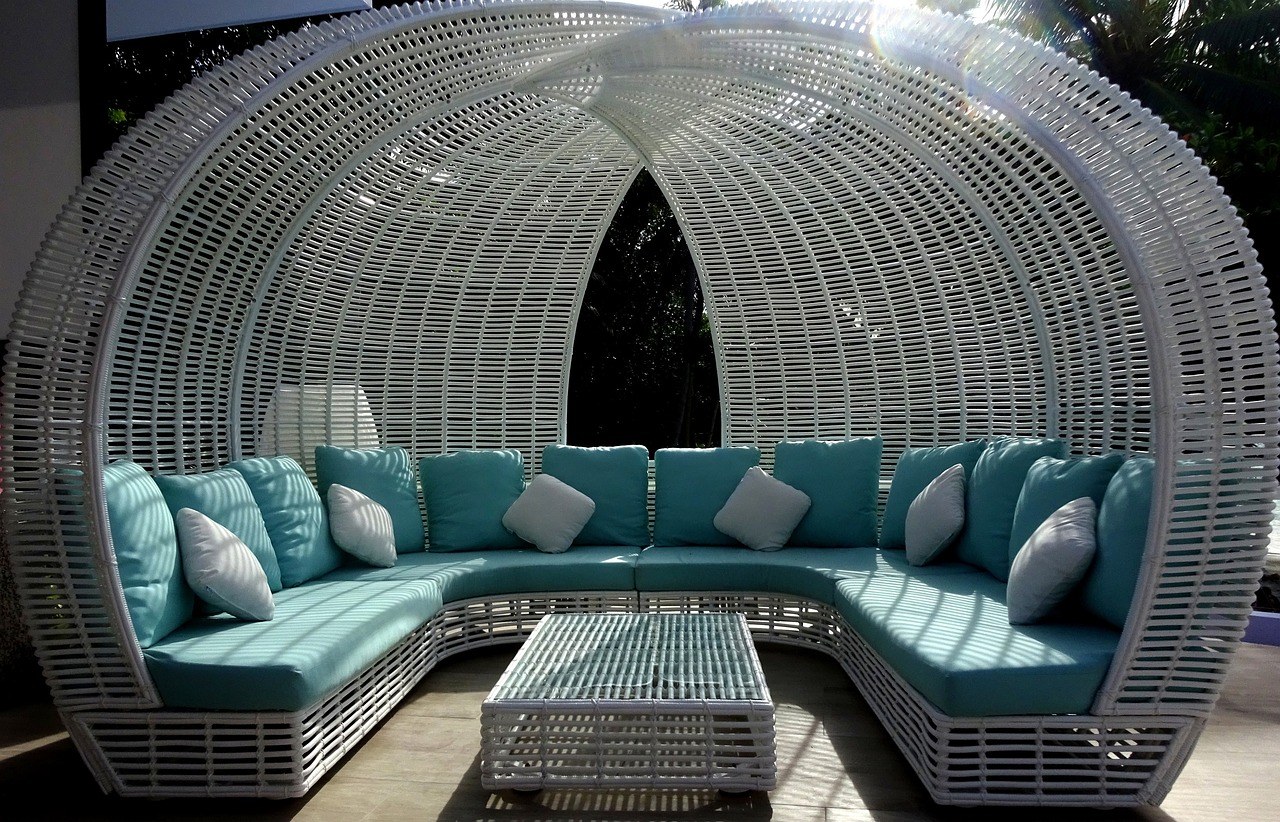
Frequently asked questions about outdoor furniture fabric and cushions
These five answers cover what buyers ask most often before placing a cushion order: fabric choice, thickness, price, minimum quantity and expected life. Each answer stands on its own and can go straight into an enquiry or an internal approval note. The short version for a hotel or restaurant order is 280 g/m2 solution-dyed acrylic, 28 to 35 kg/m3 foam, 100 to 150 mm seat thickness, 20 to 30 sets as a minimum and five to eight summers of colour life.
What fabric is best for outdoor furniture cushions?
Solution-dyed acrylic at 280 to 320 g/m2 is the best choice for contract seating. It holds lightfastness grade 6 to 7 after 1,000 hours and lasts five to eight summers. Olefin at 200 to 240 g/m2 costs 20 to 35 percent less and lasts three to five summers, which suits projects with a planned refresh. Standard polyester fades within two to three summers in high UV.
How thick should outdoor seat cushions be?
Contract seat cushions run 100 to 150 mm thick and back cushions 100 to 120 mm. Thickness does not compensate for low foam density: a 150 mm cushion at 18 kg/m3 still bottoms out within a year of daily use. Match the thickness to the frame's seat depth and set the foam at 28 to 35 kg/m3 first.
How much do custom outdoor cushions cost from China in 2026?
A three-seat cushion set in olefin is USD 35 to 65 FOB and the same set in 280 g/m2 solution-dyed acrylic is USD 60 to 110. Quick-dry foam adds USD 8 to 18 per seat and fire-retardant treatment USD 6 to 12 per cushion. Landed cost is usually 1.8 to 2.2 times FOB after freight, duty and delivery.
What is the MOQ for custom outdoor cushions?
MOQ is 20 to 30 sets per design in an existing fabric colour, 30 to 50 when the colour, foam or size is new, and 100 to 200 when the mill dyes fabric to a Pantone reference. Cushions are usually ordered with frames, because the frame quantities clear the minimum on their own and the two ship in the same container.
How long do solution-dyed acrylic cushions last outdoors?
Expect five to eight summers of colour in strong sun before visible fading, with the foam as the limiting part after three to five years of daily commercial use. Cleaning with fresh water every two to four weeks and storing cushions dry extends the cover life. Replacement covers at year four cost far less than a new cushion set.
Outdoor furniture fabric and cushions from SOLAIREVA
SOLAIREVA has manufactured outdoor furniture in Shunde, Guangdong since 2004, with a 16,000 m2 factory, 49 team members and more than 15,000 pieces a month across seating, dining, lounging and shade. Our cushion line covers solution-dyed acrylic at 240 to 320 g/m2, olefin and coated polyester, quick-dry foam at 30 to 35 kg/m3, removable covers with UV-stable zips, and custom sizes for OEM frames. We ship 15 or more high-cube containers a month, run a four-stage QC line and hold a 0.47 percent export defect rate.
Typical terms: 20 to 30 sets per design, samples in 10 to 15 days, production in 25 to 40 days, FOB Shenzhen or Nansha, fabric and foam spec sheets with every quotation, and spare covers at 3 to 5 percent of the order. Send cushion sizes, seat counts, fabric preference and the destination port through the quote request form, or start from the commercial sofa sets guide, the outdoor seating sourcing guide and the materials pages. Custom covers for your own frames are quoted through the OEM/ODM programme, and our factory page shows the cutting and sewing lines.