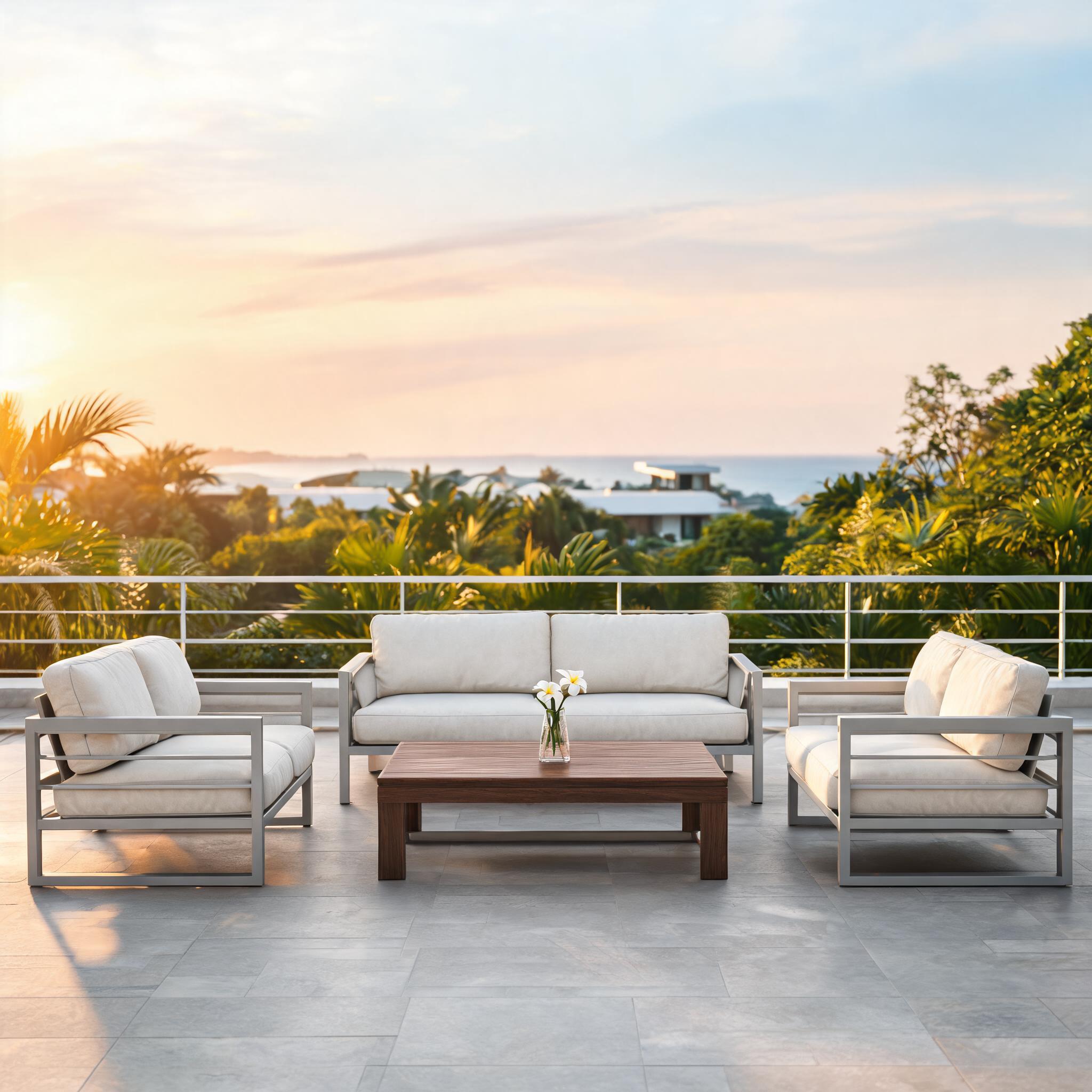
Why Sofa Sets Are the Centerpiece of Commercial Outdoor Spaces
In hotel courtyards, resort pool decks, restaurant patios, and rooftop lounges, the sofa set is almost always the visual anchor of the space. It is where guests sit longest, where photos get taken, and where comfort expectations are highest. It is also where furniture fails fastest if it is not built for commercial use.
Residential outdoor sofas look similar in a photo. The difference becomes visible in month 8 of a hotel pool deck: cushions compressed flat, fabric faded two shades, frame welds showing rust at the joints, wicker unraveling at stress points. A commercial sofa set is engineered to delay every one of these failure points by years, not months.
This guide walks through the decisions that matter most when sourcing commercial outdoor sofa sets from a China factory: which configuration to choose, what frame and cushion specifications to require, how to size for your space, and how to match sofa type to project type. If you are comparing suppliers, use the spec criteria here to create an apples-to-apples comparison - or read our guide on total cost of ownership for the financial framework.
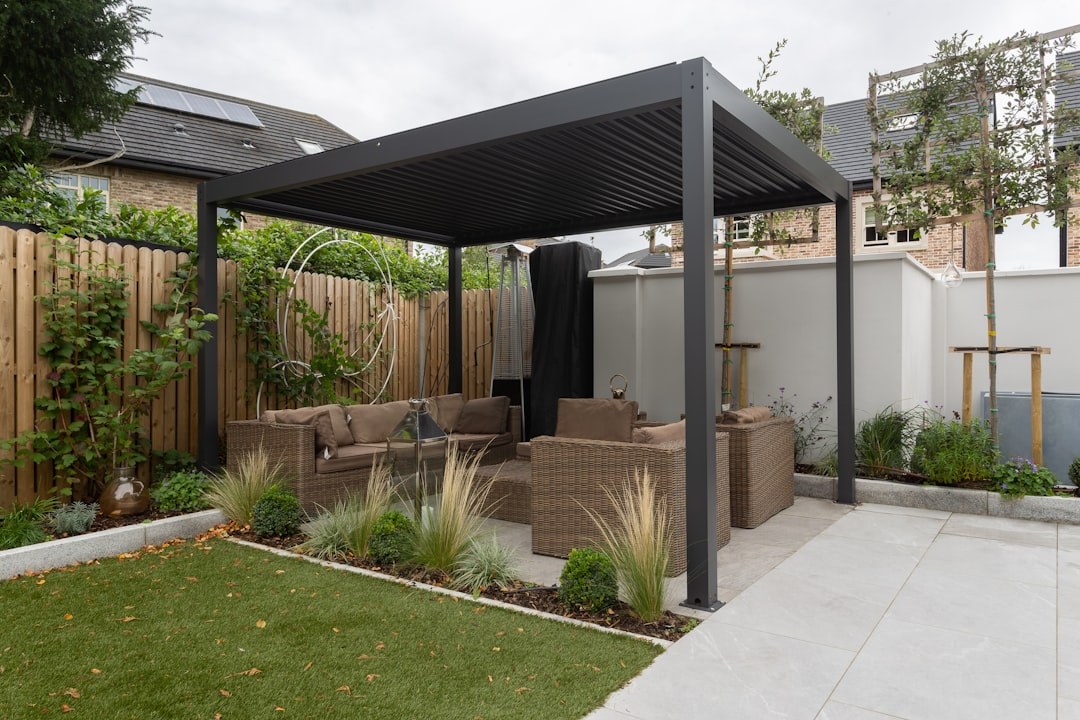
Sofa Set Configurations: Modular, Sectional, Fixed, and Custom
The configuration you choose determines not just how the sofa looks, but how your venue can use the space over time. Here is how the four main commercial configurations compare:
Modular Sofa Sets
Modular sofas are built from independent components - single-seat units, armless chairs, corner pieces, ottomans - that connect via hidden brackets or sit independently. The defining feature is flexibility: you can reconfigure a 6-piece modular set into an L-shape today, two separate sofas tomorrow, or a U-shape conversation pit next season.
Best for: Venues that reconfigure layouts seasonally or for events. Hotel pool decks that transition from day lounging to evening cocktail setups. Resort common areas where layout changes based on occupancy.
Trade-off: Modular pieces cost 15-25% more than equivalent fixed sofas because each component needs its own frame, base, and cushion system. Connection hardware adds cost and creates potential failure points if brackets loosen over time.
Sectional Sofa Sets
Sectionals are pre-configured as a single connected unit - typically L-shape or U-shape - designed to stay in one arrangement. The frame is structurally connected, not bracketed together. This makes sectionals more rigid and stable than modular, but far less flexible.
Best for: Fixed layouts where the furniture placement is permanent. Hotel lobby patios, resort conversation areas, restaurant waiting lounges. Sectionals work well when you know the space will not change.
Trade-off: If your space or usage changes, you cannot easily reconfigure. Sectionals are also harder to move for cleaning or maintenance - they are heavy and awkward to relocate.
Fixed Sofa Sets
A fixed sofa set is a straight-line sofa (2-seat, 3-seat, or 4-seat) paired with a coffee table and optionally side chairs. No corners, no curves, no reconfiguration. This is the simplest and most cost-effective configuration.
Best for: Restaurant patios with defined seating rows. Hotel balcony spaces where linear arrangements maximize capacity. Budget-conscious projects where layout flexibility is not needed.
Trade-off: No layout flexibility. If you need to reconfigure, you are physically moving the entire sofa.
Custom Configuration
For projects with unique spatial constraints - curved terraces, irregular pool shapes, architectural features that need furniture to fit around - custom configurations are the answer. Our OEM/ODM capabilities include custom frame bending, non-standard dimensions, and one-off designs built to your drawings.
Best for: Boutique hotels with distinctive architecture. Resorts with curved pool edges. Projects where the sofa set is a design statement, not just seating.
Trade-off: Higher MOQ (typically 20-50 sets), longer lead time (additional 2-4 weeks for engineering and sampling), and higher per-unit cost. See our MOQ guide for negotiation strategies on custom orders.
Frame Materials: What Commercial Sofa Sets Are Built From
The frame is the structural foundation. Everything else - cushions, weaving, finish - is replaceable. The frame is not. Getting the frame material right is the single most important spec decision for a commercial sofa set.
Aluminum Frame (Recommended for Most Commercial Projects)
Aluminum (specifically 6063-T5 alloy) is the industry standard for commercial outdoor sofa frames. It is rust-proof, lightweight enough to move for cleaning, strong enough to support commercial-grade foam and fabric, and infinitely recyclable. A well-built aluminum frame sofa will last 7-10 years in outdoor commercial use.
What to specify:
- Wall thickness: Minimum 1.2mm for standard sofas, 1.5mm for heavy-use environments (resort pool decks, high-traffic hotel lobbies). Thinner than 1.2mm risks frame flex and weld failure under commercial load.
- Powder coating: Outdoor-grade polyester powder coat, minimum 60-micron thickness. This is your corrosion and UV barrier. Indoor powder coat will chalk and fade within 12-18 months outdoors.
- Weld quality: Full-penetration TIG welds at all joints, not spot welds. Welds should be ground smooth before powder coating - visible weld lumps indicate rushed production.
- Wall brace: Commercial sofas should have at least one cross-brace under the seat platform to prevent frame racking. Residential sofas often skip this.
For a deeper comparison of aluminum against other frame materials, see our PE rattan vs aluminum analysis.
PE Rattan-Wrapped Aluminum Frame
This is an aluminum frame with PE (polyethylene) rattan woven around it for aesthetic appeal. The aluminum provides structural integrity; the rattan provides the woven look that many hospitality designers prefer. This is the most common construction for resort and hotel sofa sets.
What to specify:
- Rattan material: Virgin HDPE (high-density polyethylene), not recycled or PVC. Virgin HDPE maintains UV stabilizers and color consistency for 4-6 years. PVC rattan becomes brittle and cracks within 18-24 months.
- Weave tightness: Commercial-grade weave should have no gaps wider than 3mm between strands. Loose weaving sags and gaps widen under load.
- Weave pattern: Flat weave is easier to clean and more comfortable against skin. Round weave has more texture but collects debris in the gaps.
Steel Frame
Steel is stronger than aluminum but rusts. For outdoor commercial use, steel frames require galvanizing and powder coating - and even then, any scratch that penetrates both layers will start rusting. Steel is heavier, which can be an advantage in windy rooftop locations but a disadvantage for repositioning. We do not recommend steel for outdoor commercial sofas unless wind-load requirements specifically demand it.
Rope-Wrapped Frame
An emerging trend in hospitality design: aluminum frames wrapped in marine-grade rope (typically olefin or polyester blend). This creates a distinctive modern look popular in European boutique hotels. The rope is UV-stabilized and weather-resistant, with a lifespan of 4-6 years before replacement is needed. Our rope furniture collection uses this construction.
Cushion Systems: Where Commercial Sofas Win or Lose
If the frame determines structural lifespan, the cushion system determines daily comfort and perceived quality. Cushion failure - foam compression, fabric fading, mildew growth - is the number one reason commercial buyers replace sofa sets prematurely. Understanding cushion construction lets you specify for longevity instead of replacing every 18 months.
Foam Density
Foam density is measured in kg/m³ (kilograms per cubic meter). Higher density means the foam resists compression under repeated load. This is the single most important cushion spec for commercial use.
| Foam Density | Use Case | Expected Lifespan (Commercial) |
|---|---|---|
| 18-22 kg/m³ | Residential / light domestic | 6-12 months before visible compression |
| 24-27 kg/m³ | Light commercial (café, low-traffic) | 12-18 months |
| 28-30 kg/m³ | Standard commercial (hotel patio) | 2-3 years |
| 30-35 kg/m³ | Heavy commercial (resort pool deck, hotel lobby) | 3-4 years |
Always request foam density in writing on your specification sheet. Many suppliers will send samples with commercial-grade foam and then produce the order with residential-grade foam to reduce costs. This is the single most common quality downgrade we see in the industry.
Quick-Dry Foam
For outdoor commercial use, specify quick-dry (open-cell) foam. Standard closed-cell foam traps water between the cushion cover and foam core, creating a mildew environment that destroys fabric from the inside within months. Quick-dry foam allows water to drain through and air to circulate, reducing drying time from 48+ hours to 4-8 hours after rain. This is mandatory for any sofa set that will be rained on without being stored.
Fabric Grades
Outdoor cushion fabric for commercial use falls into three performance tiers:
- Entry commercial: Solution-dyed olefin (also branded as Olefin or polypropylene). 500+ UV hours. Colorfast for 2-3 years. Cost-effective for projects with planned 2-year refresh cycles.
- Mid commercial: Solution-dyed acrylic blends. 1000+ UV hours. Colorfast for 3-5 years. The most common choice for hotel and restaurant projects.
- High-end commercial: Sunbrella or equivalent solution-dyed acrylic. 1500+ UV hours. Colorfast for 5+ years. Water-repellent and stain-resistant finish. The standard for 5-star resorts and high-end projects.
For projects where fabric performance is critical, request the fabric's UV hour rating and colorfastness warranty from the supplier. Our materials page details the fabric options we offer across these tiers.
Cushion Construction Details
Beyond foam and fabric, commercial cushion construction should include:
- Zippered covers: For removable, washable covers. Non-removable covers cannot be properly cleaned in commercial environments.
- Reinforced seams: Double-stitched or overlocked seams at stress points. Single-stitched seams split under commercial load within months.
- Dacron wrap: A thin polyester fiber layer wrapped around the foam core. This prevents the fabric from adhering to the foam and adds a softer, more plush appearance. Commercial cushions without Dacron look flat and feel hard.
- Tie-down straps or non-slip bottoms: Cushions that slide off the frame are a daily maintenance problem in commercial settings. Specify cushions with integrated ties or non-slip backing.
Commercial vs Residential Sofa Sets: What Actually Differs
Many buyers ask whether they can use residential outdoor sofas for commercial projects to save cost. The answer depends on your tolerance for replacement frequency and liability. Here is what actually differs:
| Specification | Residential | Commercial |
|---|---|---|
| Frame wall thickness | 0.8-1.0mm | 1.2-1.5mm |
| Frame cross-brace | Often none | Minimum 1 cross-brace |
| Foam density | 18-22 kg/m³ | 28-35 kg/m³ |
| Foam type | Closed-cell standard | Quick-dry open-cell |
| Fabric UV hours | 200-500 hours | 500-1500+ hours |
| Seam construction | Single-stitched | Double-stitched / overlocked |
| Weld quality | Spot weld acceptable | Full-penetration TIG |
| Powder coat thickness | 40-50 microns | 60+ microns |
| Warranty | 1-2 years residential use | 2-5 years commercial use |
The price difference between residential and commercial sofa sets is typically 30-50%. The lifespan difference is 2-4x. For a 5-year cost analysis, commercial-grade is almost always the lower total cost.
How to Choose Sofa Sets by Project Type
Different project types have different requirements. Here is how to match sofa set specifications to your venue:
Hotel Lobby and Courtyard
Priorities: Visual impact, guest comfort, brand alignment, durability for 12-16 hour daily use.
Recommended spec: Aluminum frame with PE rattan wrapping or rope wrapping. Modular configuration for layout flexibility. Foam density 30+ kg/m³. Sunbrella or equivalent fabric. Custom powder coat color to match hotel brand identity. Include side tables and coffee table in matching design.
Common mistake: Choosing deep-seating sofas (seat depth > 55cm) for lobby areas where guests sit briefly. Deep seating encourages longer loitering in spaces meant for transit. Standard seat depth (48-52cm) is better for lobby use.
Resort Pool Deck
Priorities: Water resistance, UV resistance, chlorine resistance, easy to clean, stackable or movable for off-season storage.
Recommended spec: Bare aluminum frame (no rattan wrapping - rattan traps moisture and chlorine residue in pool environments). Quick-dry foam mandatory. Olefin or solution-dyed acrylic fabric. Modular or fixed configuration. Consider stackable single-seat units for flexibility.
Common mistake: Specifying PE rattan sofas for pool decks. Chlorine and sunscreen residue accelerate rattan degradation. Bare powder-coated aluminum is significantly more durable in pool environments. See our resort poolside solution for pool-specific furniture recommendations.
Restaurant Patio
Priorities: Seat turnover (guests sit for 60-90 minutes, not all day), easy to clean between seatings, spill-resistant fabric, fire code compliance.
Recommended spec: Fixed 2-seat or 3-seat sofas. Foam density 28-30 kg/m³. Stain-resistant fabric finish (Sunbrella or equivalent with stain treatment). Seat height 42-45cm (standard dining height encourages faster turnover than deep lounge height at 35-38cm). Avoid white or light-colored cushions - they show every spill.
Common mistake: Using lounge-height sofas (seat height 35-38cm) for dining-adjacent patios. Guests eating at lounge height is uncomfortable and increases spill risk. Match sofa seat height to adjacent dining chair height.
Rooftop Bar and Lounge
Priorities: Wind resistance, weight stability, UV exposure (rooftops have no shade), fire safety.
Recommended spec: Heavier frame construction (consider steel reinforcement in wind-exposed locations). Modular deep-seating configuration. Foam density 30+ kg/m³. High-UV-rated fabric (rooftops receive maximum sun exposure). Ensure furniture weight is sufficient to resist wind displacement, or specify anchoring systems.
Common mistake: Lightweight aluminum sofas on exposed rooftops without anchoring. Wind can displace lightweight furniture, creating safety liability. Specify minimum weight or anchoring for rooftop installations.
Villa and Boutique Property
Priorities: Design uniqueness, material quality, customization options, lower MOQ flexibility.
Recommended spec: Custom configuration with OEM design elements. Mixed material frames (aluminum + rope, aluminum + teak accents). High-performance commercial fabric. Consider our villa furniture solutions for customization options including custom dimensions, exclusive colors, and branding.
Sizing Standards and Layout Planning
Commercial sofa sizing follows different standards than residential. Getting dimensions wrong means either wasted space (sofa too small for the area) or cramped layouts (sofa too large, blocking walkways).
Standard Commercial Sofa Dimensions
| Type | Width | Depth | Seat Height | Back Height |
|---|---|---|---|---|
| 2-seat sofa | 120-140cm | 75-85cm | 42-45cm | 65-75cm |
| 3-seat sofa | 180-210cm | 75-85cm | 42-45cm | 65-75cm |
| L-shaped sectional | 220-260cm (each side) | 75-85cm | 42-45cm | 65-75cm |
| Deep lounge sofa | 180-220cm | 90-100cm | 35-38cm | 60-70cm |
| Ottoman | 60-80cm | 60-80cm | 35-38cm | - |
Layout Spacing Rules
For commercial spaces, minimum clearances around sofa sets:
- Walkway behind sofa: Minimum 90cm (120cm for wheelchair-accessible venues)
- Distance to coffee table: 40-50cm (enough to extend legs, close enough to reach drinks)
- Distance between facing sofas: 180-220cm (enough for a coffee table and legroom)
- Distance to dining area: Minimum 150cm to prevent cross-traffic interference
- Pool deck clearance: Minimum 100cm from pool edge to furniture (many jurisdictions require 150cm - check local codes)
For detailed space planning guidance, including how many sofa sets fit in standard patio and pool deck sizes, our resort pool layout guide covers this in depth.
MOQ and Pricing Structure
Understanding how China factories price commercial sofa sets helps you negotiate effectively and avoid hidden cost surprises.
Typical MOQ by Configuration
- Standard catalog sofa sets: 10-20 sets per design. Standard catalog means existing frame designs with standard dimensions and standard fabric options.
- Modified catalog (custom dimensions or fabric): 15-30 sets. Modifications include changing seat depth, adding/removing seat sections, or specifying non-standard fabric.
- OEM custom sofa designs: 20-50 sets. Fully custom designs built from your drawings, including new frame engineering.
- Mixed container orders: You can combine sofa sets with dining sets, loungers, and other products to meet total container volume. This is the most cost-effective approach for buyers who need variety but cannot meet per-SKU MOQs.
What Drives Price
Commercial sofa set pricing is driven by these factors, in order of impact:
- Frame material and wall thickness - Aluminum cost is the largest material input. Thicker walls = higher cost but longer lifespan.
- Cushion system - Foam density and fabric grade together account for 25-35% of total sofa cost. This is where most quality downgrades happen.
- Rattan or rope wrapping - Hand-wrapping is labor-intensive. Complex weave patterns cost more than simple weaves.
- Configuration complexity - Modular costs more than fixed. Sectional costs more than straight. Custom curved frames cost significantly more.
- Order quantity - Price per unit drops meaningfully at 30+ sets and again at 50+ sets due to production line efficiency.
- Custom branding - Laser engraving, custom woven labels, and custom packaging add 5-15% to unit cost depending on complexity.
For a detailed breakdown of how to compare supplier quotes on an apples-to-apples basis, including the 12 factors beyond unit price that you need to evaluate, see our MOQ negotiation guide.
Quality Inspection: What to Check Before Accepting Delivery
When your commercial sofa sets arrive, inspect against your specification sheet before accepting. The most common quality issues in China-sourced commercial sofas are:
- Foam density downgrade: The most common issue. Weigh a cushion and measure its dimensions to calculate actual density. If the supplier specified 30 kg/m³ and the delivered cushion calculates to 24 kg/m³, you have been downgraded.
- Fabric substitution: Supplier sends samples with Sunbrella and produces with generic olefin. Request fabric swatches from the production batch and compare UV hour ratings.
- Wall thickness reduction: Measure frame wall thickness with a caliper at a cut end or weld point. Thinner than specified is a structural downgrade.
- Powder coat quality: Run a coin test - if powder coat flakes off under moderate pressure, the coating is too thin or improperly cured.
- Weave gaps: For rattan-wrapped frames, check gap consistency. Gaps wider than 3mm indicate rushed or low-skill weaving.
For a comprehensive inspection process, our receiving inspection checklist walks through every checkpoint with documentation templates.
Frequently asked questions about commercial outdoor sofa sets
What is the difference between modular and sectional outdoor sofa sets?
Modular sofa sets are built from independent pieces (single seats, corner units, ottomans) that can be rearranged freely. Sectional sofas are pre-configured as a single connected unit (L-shape, U-shape) that stays in one arrangement. Modular offers layout flexibility for venues that reconfigure spaces seasonally; sectional is more cost-effective and structurally rigid for fixed layouts.
What foam density do I need for commercial outdoor sofa cushions?
For commercial use, minimum foam density should be 28-30 kg/m³ for seating cushions. High-traffic venues (hotel lobbies, restaurant patios) should specify 30-35 kg/m³ density with quick-dry (open-cell) foam structure. Standard residential foam at 18-22 kg/m³ will compress within 6-12 months of commercial use. Always request foam density in writing on your spec sheet.
How long do commercial outdoor sofa sets last?
With proper commercial-grade construction, an aluminum frame sofa set lasts 7-10 years in outdoor commercial use. Cushions and fabric typically need replacement every 2-4 years depending on UV exposure and traffic. PE rattan-wrapped frames last 4-6 years before showing significant weave degradation. Total cost of ownership over 5 years is significantly lower with commercial-grade than residential-grade furniture.
What is the MOQ for commercial outdoor sofa sets from a China factory?
MOQ for standard catalog sofa sets typically starts at 10-20 sets per design. For OEM custom sofa designs with custom dimensions or branding, MOQ is 20-50 sets. Mixed-container orders allow combining sofa sets with dining sets and loungers to meet total volume. Contact the factory with your project scope for a specific MOQ based on configuration complexity.
Can I get custom cushion fabrics and colors for commercial sofa sets?
Yes. Standard production offers a curated range of commercial-grade outdoor fabrics (typically 20-40 color options). For fully custom fabric, the factory can source specific brands (Sunbrella, Outdura) and custom colors with MOQ typically 50+ meters per color. RAL color matching is available for powder-coated frames to align with your brand identity.
Source commercial outdoor sofa sets from SOLAIREVA
Commercial outdoor sofa sets are an investment in guest experience and brand perception. Getting the specifications right - frame wall thickness, foam density, fabric UV rating, weave quality - is the difference between furniture that lasts a season and furniture that lasts a decade.
At SOLAIREVA, we manufacture commercial sofa sets in our 16,000 m² Shunde factory with aluminum 6063-T5 frames, commercial-grade quick-dry foam (28-35 kg/m³), and solution-dyed acrylic fabrics. Our QC process inspects frame wall thickness, weld quality, powder coat thickness, foam density, and fabric UV rating on every production batch.
Next steps: Browse our sofa set collections to see standard configurations, or request a custom quote with your project specifications. For OEM custom designs, see our OEM/ODM capabilities page for the full customization process.