Why Outdoor Furniture Factories Set MOQs — and What Actually Determines Them
If you have ever received a quote that says "MOQ: 50 pieces per SKU" and wondered why the number seems arbitrary, you are not alone. MOQs in outdoor furniture manufacturing are not random — they are a direct function of production economics. Understanding what drives them is the first step to negotiating them.
Three factors determine factory MOQs:
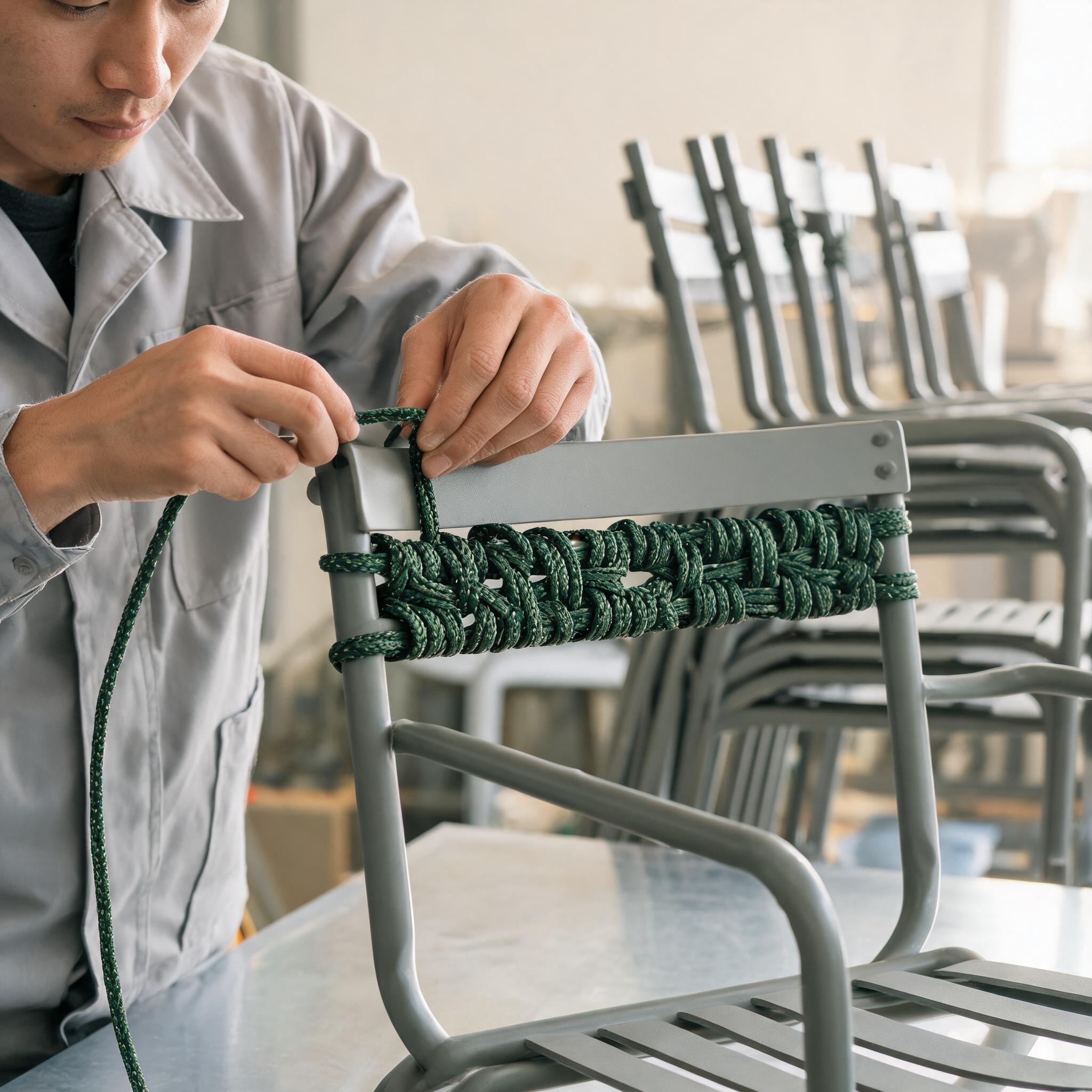
- Material procurement minimums. Aluminum extrusions are ordered in minimum tonnage from the mill. PE rattan comes in 500 kg spool minimums from our HDPE suppliers. Fabric mills require 200-300 meter runs for custom colors. A factory cannot buy 50 meters of custom Sunbrella fabric — the mill simply will not produce it.
- Production line setup cost. Switching a welding jig, powder coat color, or weaving pattern takes 2-4 hours of line downtime. If you order 5 pieces, the setup cost per piece is enormous. If you order 100 pieces, that same setup cost is spread thin. MOQ is essentially the point where setup cost per unit becomes acceptable.
- Container economics. A 20ft container fits roughly 40-60 dining sets or 25-35 sofa sets depending on design. If your order fills less than 30% of a container, the per-unit freight cost becomes disproportionate. Most factories prefer MOQs that align with at least a half-container load.
At SOLAIREVA, our standard MOQ for aluminum frame products is 20-50 units per SKU, and 30-80 for fully custom rattan designs. But these numbers are starting points, not walls — and the five strategies below will show you exactly how to work with them.
Strategy 1: Use Standard Materials and Finishes
The single fastest way to reduce MOQ is to stay within the factory's existing material inventory. When you specify a custom RAL powder coat color that requires a special order from the coating supplier, you are adding a material minimum to your order. When you choose from the factory's standard color palette — typically 12-20 powder coat options and 8-15 fabric colors already in stock — you are ordering from material that is already on the shelf.
At SOLAIREVA, this typically means:
- Standard frame colors (black, white, grey, bronze, taupe): MOQ as low as 20 units
- Standard PE rattan colors (natural, grey, dark brown, black): same low MOQ
- Custom RAL-matched powder coat: MOQ typically 50+ units due to coating supplier minimums
- Custom fabric from Sunbrella or equivalent mills: MOQ 80+ units due to mill minimum order lengths
If customization is critical to your project but budget constraints limit order size, consider our OEM process guide — it includes a section on balancing customization level against MOQ requirements.
Strategy 2: Combine Multiple SKUs in Mixed Containers
This is the most underutilized MOQ strategy in the industry. Most buyers assume they need to meet MOQ separately for each product — 50 dining sets, 50 sun loungers, 50 umbrellas. But that is not how mixed container orders work.
A mixed container approach lets you:
- Order 15 dining sets + 15 sun loungers + 10 umbrellas + 10 side tables = 50 total pieces across 4 SKUs
- Each SKU shares the same production run scheduling, container loading, and documentation
- Per-unit MOQ drops because total order volume qualifies for production economics
The key constraint is production compatibility. Products that share the same material type (all aluminum frames, or all PE rattan) can be produced together more efficiently than mixing aluminum with teak and rattan in one small order. At SOLAIREVA, we help buyers structure mixed containers that maximize volume while minimizing SKU-level minimums — typical mixed container MOQ is 30-50 total pieces across 2-4 compatible SKUs.
For a detailed breakdown of container capacity, see our container loading calculator.
Strategy 3: Start With Sample Orders, Then Scale
First-time buyers often face a chicken-and-egg problem: the factory wants a 50-unit MOQ to justify production, but you want to test the product with 5-10 units before committing to volume. The solution is a structured sample-to-production pathway.
How this works at SOLAIREVA:
- Sample stage (1-3 units). We produce samples at sample pricing (typically 1.5-2x the volume unit price). These are built to production spec using the same materials and processes, so what you see is exactly what you will receive at scale.
- Pilot order (10-20 units). After sample approval, a pilot order lets you test market response or conduct durability testing at your own facility. Pilot MOQ is lower because we have already built the jigs and proven the production process during sampling.
- Volume production (50+ units). Once the pilot validates the design, full production pricing applies.
The entire pathway takes 8-14 weeks from sample to volume delivery, but it removes the risk of committing to 50 units of a design you have never seen in person. For more on the sampling process, read our complete OEM guide.
Strategy 4: Time Your Order With Existing Production Runs
This is an insider tactic that few buyers know about. When a factory is already running a large production batch — say, 500 aluminum dining chairs for a hotel chain — adding your 20-unit order to the same production run can effectively eliminate the setup cost that drives MOQ.
The conditions for this to work:
- Your product shares the same frame construction method as the running batch (same welding jig, same tube profiles)
- You are flexible on delivery timeline (your order is produced during the existing production window, not on a separate schedule)
- Your finish can be the same as or easily switched from the running batch's finish
At SOLAIREVA, we maintain a production calendar that our sales team can reference. Ask your account manager: "Is there a production run in the next 4-6 weeks that my order could piggyback on?" If the answer is yes, you could see MOQ drop from 50 to 20 units with no price penalty.
Strategy 5: Build a Relationship Through Repeat Orders
MOQ is partly a trust mechanism. A factory that has never worked with you does not know if you will place one order and disappear, or become a long-term partner. First-order MOQ is always the highest because the factory is pricing in the risk of a one-off production setup.
Concrete ways to build purchasing credibility:
- Provide a 12-month forecast — even a rough one. "We expect 3 orders this year, 50-80 units each" signals that you are a recurring buyer, not a one-time shopper.
- Start with standard products at standard MOQ for your first order, then negotiate lower MOQ on order 2 and 3.
- Offer a slightly longer lead time on your first order in exchange for a lower MOQ. Factories value production planning flexibility.
- Pay the sample and tooling costs upfront — this demonstrates commitment and removes the factory's financial exposure on custom work.
Our repeat buyers at SOLAIREVA typically see MOQ flexibility of 30-50% below standard starting from their second order. The factory already has your molds, jigs, and quality standards on file — each reorder costs less to set up.
What MOQ Looks Like at SOLAIREVA (Reference Table)
| Product Type | Standard MOQ | Mixed Container MOQ | Repeat Order MOQ |
|---|---|---|---|
| Aluminum dining set (standard finish) | 30 sets | 15 in mixed container | 20 sets |
| PE rattan sofa set (standard color) | 20 sets | 10 in mixed container | 15 sets |
| Sun lounger (aluminum frame) | 50 units | 20 in mixed container | 30 units |
| Custom design (new tooling required) | 50-80 sets | N/A (single SKU) | 30-50 sets |
| Umbrellas / side tables | 30 units | 10 in mixed container | 20 units |
These are reference figures for planning purposes. Actual MOQ depends on product specifications, material availability, and production scheduling. Contact our team with your product requirements for a specific proposal.
Frequently asked questions about MOQ
Can I get a lower MOQ if I pay a higher unit price?
Yes — this is the most common MOQ negotiation outcome. For orders below standard MOQ, a 10-20% unit price surcharge covers the disproportionate setup cost. At SOLAIREVA, we are transparent about the surcharge calculation so you can decide whether the trade-off makes sense for your project.
What is the absolute minimum I can order from SOLAIREVA?
For standard catalog products: 10 units per SKU (with surcharge). For custom designs: a pilot order of 10-20 units after sampling. Below these thresholds, we recommend our sample program (1-3 units) to evaluate quality before committing to production quantities.
Does MOQ apply per color or per design?
Per design (SKU). If you order the same sofa set in 3 colors, the MOQ is typically the total across all colors, not per color. However, if each color requires a separate powder coating batch, a small batch surcharge may apply for colors below 10 units.
How do I handle MOQ for a hotel project with 8 different furniture types?
Mixed container ordering is the standard solution. You combine dining sets, lounge sets, sun loungers, umbrellas, and side tables into one consolidated order. The total volume across all items qualifies for production economics, even if individual SKU quantities are small. This is the most common ordering pattern for hotel and resort projects.
Get a custom MOQ proposal for your project
Every project has unique constraints — budget, timeline, design requirements, and quantity. The five strategies above work in combination, and the optimal approach depends on your specific situation. Our sales team can calculate MOQ options within 1-2 business days if you provide the following:
- Product types and quantities needed
- Material and finish preferences (standard or custom)
- Target budget range
- Timeline requirements
- Whether this is a one-time order or part of an ongoing project