
At SOLAIREVA, we've been manufacturing outdoor furniture in Shunde, Guangdong for over 20 years. In our 3 years of direct exports to the US, Germany, France, Australia, Middle East, and developed African markets, our sourcing advisors have talked to hundreds of buyers who arrived in China thinking they found a great factory deal — only to discover they were dealing with a trading company renting someone else's production space.
Buyers who arrive at "factory" addresses in Guangdong sometimes find a 3-floor office building with 8 people making calls, while the actual production line is 45 minutes away in a different city. A European hospitality buyer told our team they wired a 30% deposit to a supplier who vanished two weeks later. When they flew to China, the address on the business license was a residential apartment building. The "factory" in the video tour? They had borrowed footage from a real manufacturer 60km away.
Certification PDFs get edited often enough that our team now insists on verifying serial numbers directly with the issuing body — no exceptions. One procurement lead from a Middle East resort chain shared that they accepted certificate PDFs without checking, only to discover halfway through production that none of the documents were authentic. The supplier had simply taken real certificates from another company and edited the name.
That's why we built this 12-point verification system. It's the same process we use when vetting partner factories for specialized orders, and the same checklist we walk every client through before they place their first order with us. It takes about 3 days to run through completely, and costs maybe $150 in third-party verification fees. The days of "trust but verify" are over. We verify first, then trust only when every checkpoint passes.
The 12-point verification checklist
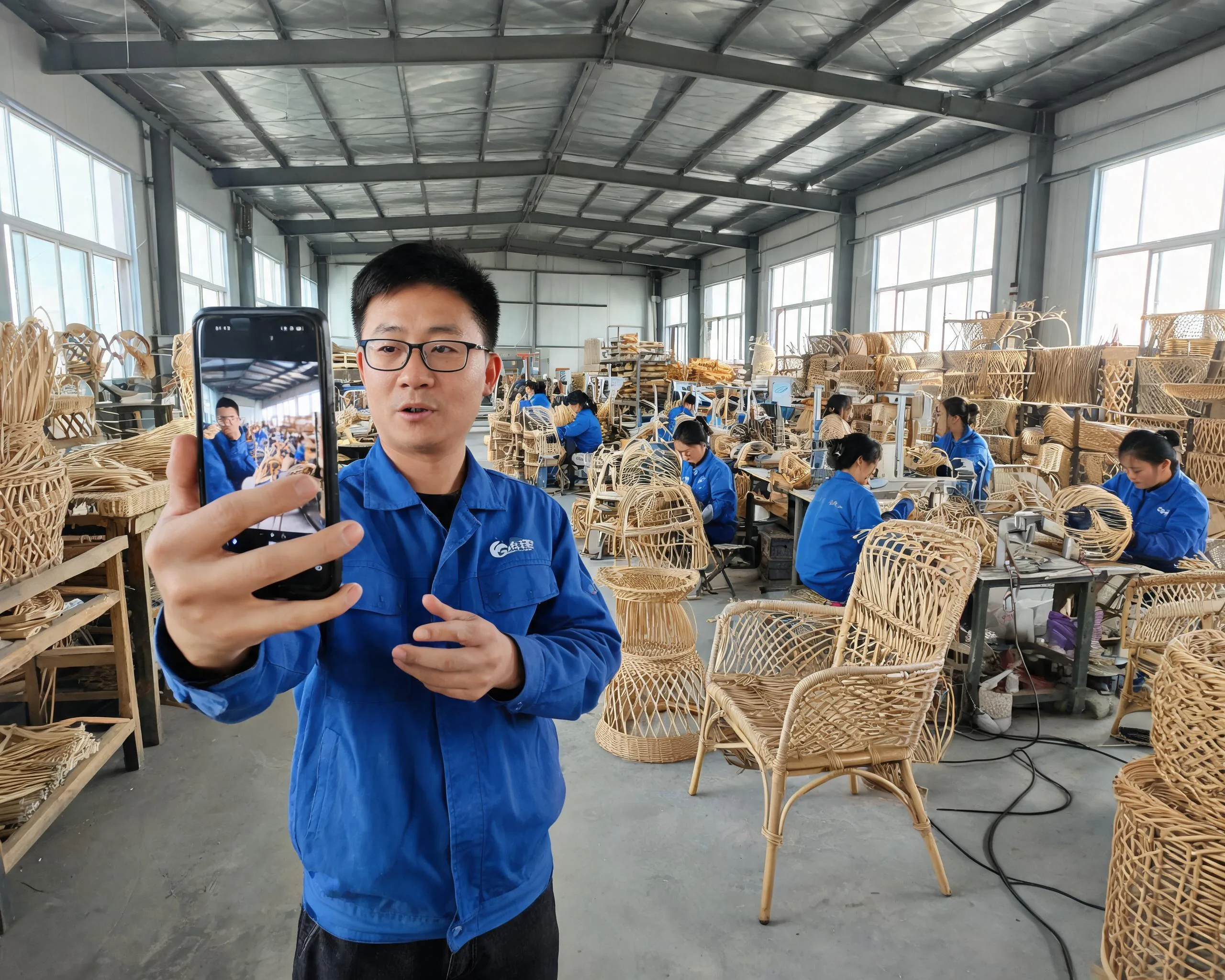
This is the exact checklist we run on every Chinese outdoor furniture supplier before we recommend any buyer sends even $1 in deposit. We don't care how good their website looks, how professional their sales rep sounds, or how many "customer testimonials" they have posted. Every single one of these must pass.
| # | Verification checkpoint | Time to verify | Difficulty | Skip means |
|---|---|---|---|---|
| 1 | Business license original video verification | 15 min | Easy | You're dealing with a shell company or someone impersonating a real factory |
| 2 | Supplier company name 100% matches bank account beneficiary name | 10 min | Easy | Payment goes to a personal account or unrelated third party; nearly impossible to recover if something goes wrong |
| 3 | Google Maps Street View address verification + employee count matches factory size | 20 min | Easy | They're using someone else's factory address; a 16,000 m² facility needs at least 40-50 production workers |
| 4 | Live unscripted video call with specific on-demand requests | 30 min | Medium | They can't show you real production because they don't own or have access to the factory |
| 5 | Certification serial numbers traceable to issuing body's public database — any authentic third-party audit report is verifiable this way | 45 min | Medium | Most Chinese furniture suppliers post edited certificates; serial numbers don't exist in official databases |
| 6 | Three reference customers you can actually call (not just written testimonials) | 2 hours | Medium | They have no real repeat customers; references are either fake or employees posing as clients |
| 7 | Raw material supplier invoice copies for aluminum, PE rattan, and hardware | 30 min | Medium | Trading companies buy finished goods, not raw materials; they can't produce these invoices |
| 8 | Bill of Materials breakdown to component level, not just category totals | 1 hour | Hard | Real factories have exact BOMs; traders only have supplier price lists with aggregated costs |
| 9 | Production photos with intact EXIF data + capture date within last 30 days | 20 min | Easy | They're using old stock photos from someone else's factory; nothing they show is current |
| 10 | Proforma invoice or sample fee receipt with company seal matching business license | 15 min | Easy | Trading companies often use generic stamps or no stamp at all; real factories have registered official seals |
| 11 | QC report sample from a recent similar order, with inspector name and date | 45 min | Medium | If they can't show you a real QC report, they don't do QC; you're buying uninspected goods |
| 12 | Unannounced visit acceptance (they must allow visits with < 48 hour notice) | 5 min | Easy | Trading companies need time to "arrange" a factory visit; real factories welcome walk-ins anytime |
Let us break down the critical ones most people miss. For the business license video, we don't accept a photo or PDF. We make them hold the original physical license up to the camera on a live call, and we read every character against the registration number on China's National Enterprise Credit Information Publicity System. Our team has seen three suppliers try to pass off edited PDF licenses where they changed the registered capital and business scope.
For the Google Maps check, we don't just look at the pin. We drop into Street View and walk around the building. We count the loading docks, look for the company name on the exterior, check if there are delivery trucks parked outside. One supplier had a factory listed at an address that Street View showed was a parking garage. Another had a 5,000 m² building but claimed 200 employees — that's physically impossible, outdoor furniture production needs about 40 m² per worker when you account for material storage and production lines.
The live video call test is the single most effective fake factory detector. We always ask for at least three specific things we haven't mentioned before: "Point the camera at your wall clock right now," "Show me the fire extinguisher near the cutting station," "Walk over to the raw material rack and read me the label on that aluminum coil." Fake factories renting someone else's space can never do this. Real factories don't even hesitate. Last year we had a supplier try seven times to reschedule a video call, each time with a different excuse. We walked away. Two months later we saw them on a Chinese government blacklist for export fraud.
What a misrepresented factory actually looks like
Our sourcing advisors have encountered dozens of suppliers who misrepresent their capacity or ownership. These are the three cases that taught us the most.
Case 1: The disposable cutlery "furniture factory"
The first was a company claiming to be based in Foshan. Their website had beautiful workshop photos, all the right audit documentation posted, and a sales rep who spoke perfect English. They exchanged emails with a US buyer for three weeks. They gave three reference contacts — all US phone numbers, all of whom answered and gave glowing reviews. Everything felt legitimate. The buyer was about to send a deposit for 320 dining chairs. At the last minute, we walked them through the full checklist. When they asked for the business license video, the supplier said the boss had it with him on a business trip. Next day, they sent a PDF. We looked up the registration number. The real company made disposable cutlery, not furniture. The scammers had taken a real business license, edited the name, and posted it on their website. When confronted, they stopped replying immediately. The three "references"? All VoIP numbers rented for $5 a month, answered by people working for the scam ring.
Case 2: The three-factory "single facility"
The second one was more sophisticated. A supplier actually had a real factory address in Shunde, and they did make outdoor furniture — just not at the scale they claimed. They said they had 120 employees and a 25,000 m² facility. Their quotes were 10% below market, which seemed reasonable for a larger factory. A French hotel chain scheduled a video tour. The supplier showed a busy workshop, workers weaving PE rattan, aluminum frames being welded. Everything looked real. Then the buyer asked them to pan the camera to the back wall. They hesitated, then said the camera battery was dying and they'd have to call back. That triggered us. We recommended the buyer hire a local third-party auditor to do an unannounced visit the next day. The auditor found a 3,000 m² workshop with 17 employees. The "factory tour" the buyer had been shown? They had partnered with three other small workshops nearby, and when clients ask for a tour, they shuttle them between all four locations, pretending it's one big facility. The production capacity they quoted was quadruple what they could actually deliver.
Case 3: The completely fabricated identity
The third case almost caught an Australian resort developer. The supplier was based in Shenzhen, which is unusual — most furniture factories are in the Foshan or Shunde area. But their prices were reasonable, they had all the right audit reports posted, and their website was very professional. They even arranged a factory tour. The developer went to China for the visit. The factory was real, the workers were there, everything looked perfect. But then our team noticed something: all their audit reports had been issued in the last six months. We asked to see raw material invoices. They provided them. But the supplier names seemed off. We ran a check on those supplier companies. All of them had been registered within the last year, all at residential addresses. Turned out this was a trading company that had created an entire fake factory identity.
Video-audit vs on-site audit vs third-party audit
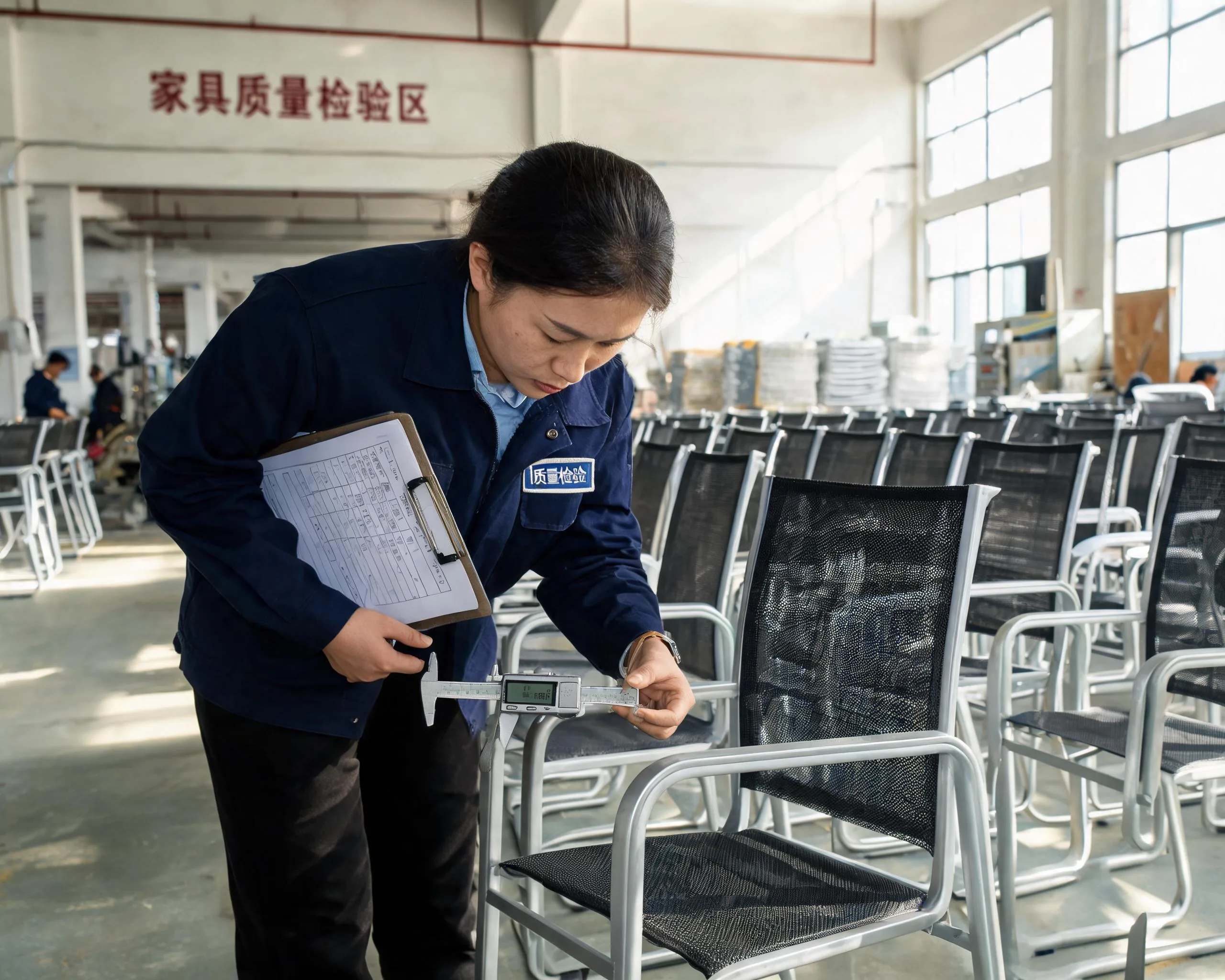
Not all verification methods are equal. Here's how they compare, and when we recommend which.
| Audit method | Cost | Time required | Depth of verification | Reliability of findings | Best for |
|---|---|---|---|---|---|
| Live video self-audit | $0 | 30-60 minutes | Medium-high | 7/10 | Initial screening, progress checks during production |
| Third-party local audit | $120-250 | 2-3 business days | High | 9/10 | Final verification before deposit, mid-production QC checks |
| In-person on-site audit | $1,500-3,000 (flight + hotel) | 1-2 days | Very high | 10/10 | First order over $50,000, annual supplier reviews |
We start every new supplier vetting with the video self-audit using this 12-point checklist. This catches 80% of the misrepresentations right away, for zero cost. If they pass the video audit and we're recommending a buyer place an order under $30,000, we move straight to the third-party local audit. There are dozens of companies in Foshan and Guangzhou that do this for $120-250 per audit. They send someone to the factory unannounced, take photos, verify the business license against what's posted at the entrance, count employees, check that production is actually happening, and even verify that the QC processes they claim to use are real. We have never had a supplier pass a third-party audit turn out to be fraudulent.
For orders over $50,000, we always recommend the buyer go in person — or we send our own team from our Shunde facility. Yes, it costs money and takes time. But losing a $50,000 deposit costs a lot more. When we visit in person, we don't just take the scheduled tour. We show up 30 minutes early. We ask to see the raw material storage area. We look at the production logs. We talk to workers to confirm they're actually employed by the company. Our team once showed up to a "factory" visit 45 minutes early, and they were still putting up their company signs on the building walls.
One thing we never recommend: relying on B2B platform "verification." Those are paid services. Suppliers pay platforms to do a basic check that the business exists. They don't verify that the business actually manufactures what they say they do. We've seen dozens of "Gold Suppliers" turn out to be pure trading companies with zero production capacity. Platform verification is marketing, not due diligence.
The pre-wire framework we run with every client
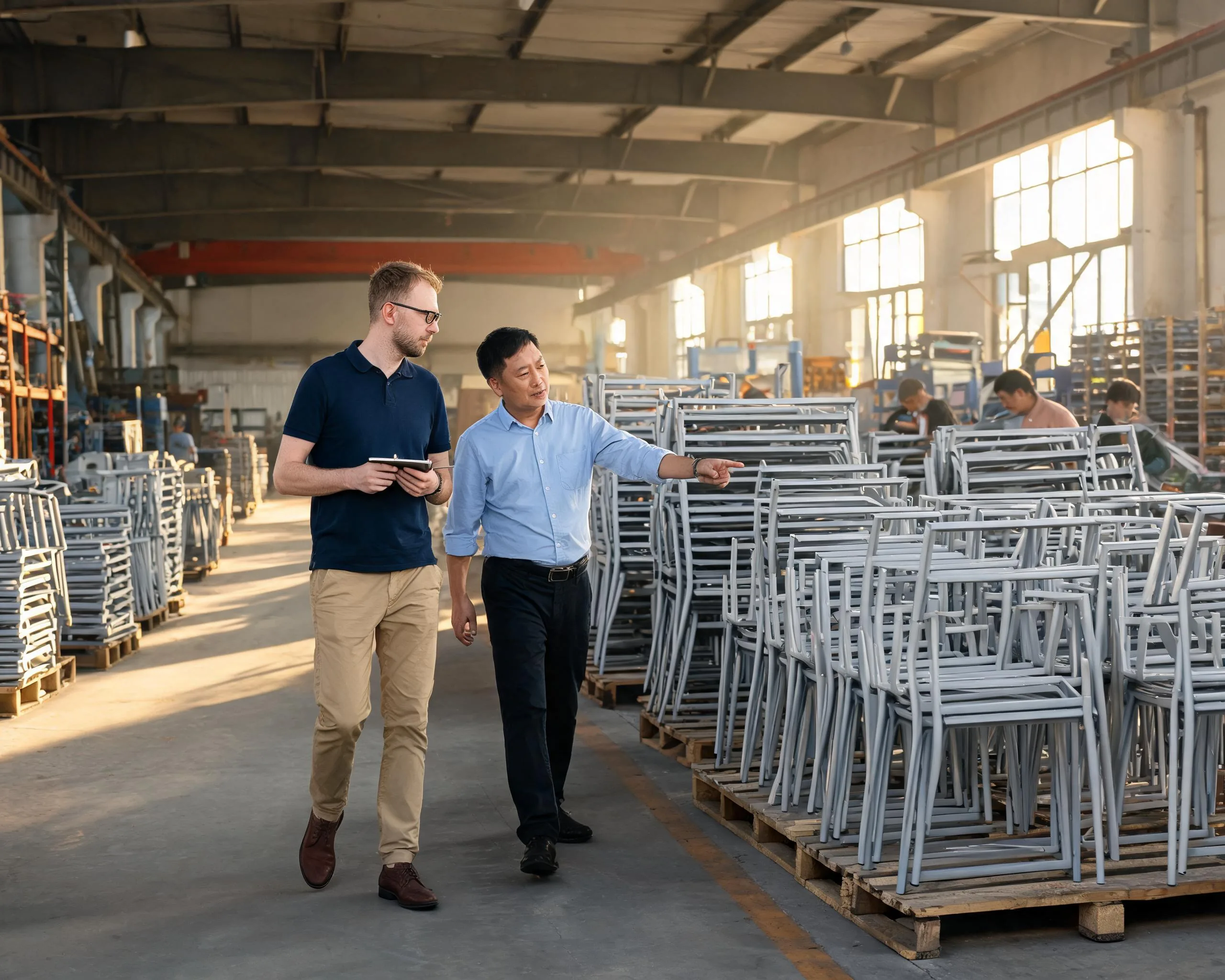
Before any buyer wires any money, no matter how well the audits went, we walk them through this final decision framework.
1. All 12 checklist items must have a clear pass. No "they promised to send it later." No "we can provide that after deposit." Everything is provided upfront.
2. The person the buyer is emailing must actually work at the company. We check their name on the business registration filings, or we ask to see their employee ID on a video call. Scammers often use fake names and work from home offices.
3. The payment beneficiary name must exactly match the business license name, character for character. If the business license says "Foshan Shunde SOLAIREVA Outdoor Furniture Co., Ltd," that's exactly what the bank account name must say. No abbreviations, no alternative names, no personal accounts. This is non-negotiable. If they ask you to pay to a different company "for tax purposes," walk away immediately.
4. The payment terms must be standard: 30% deposit, 70% balance against copy of bill of lading. Any supplier asking for 50% or more deposit, or full payment upfront, is a huge red flag. Real factories operate on 30% deposits. At SOLAIREVA, we've used these standard terms with every export client since we began direct shipments 3 years ago.
5. They must provide a written production timeline with specific check-in dates. At minimum: raw material arrival date, frame production completion date, weaving start date, final QC date, container loading date. We help clients schedule video checks for each of these dates before they send the deposit.
6. They must agree in writing that the buyer can send a third-party inspector at any time during production, at their cost, and if the inspection fails, they can cancel the order and get their deposit back. Any supplier that refuses third-party inspections is hiding something. SOLAIREVA actually encourages this — we have nothing to hide in our 16,000 m² Shunde facility with 49 skilled workers running our 4-stage QC process.
7. Finally, trust your gut. If something feels off, if they're evasive with answers, if they keep rescheduling calls, if the sales rep sounds too good to be true — walk away. There are thousands of legitimate furniture factories in China, concentrated right here in Shunde where we've operated for 20+ years. You don't need to do business with the one that makes you uncomfortable.