
One European hospitality buyer we now work with placed identical 40HQ orders of outdoor dining sets through two different suppliers in Guangdong. Same PE rattan, same aluminum thickness, same cushion density. One quoted 12% below the other. Both delivered on time. Both passed initial QC.
They thought they'd gotten a great deal — until they realized the more expensive supplier was just a trading company marking up the exact same factory's products. That difference? Pure middleman fee. No extra service, no better quality, just someone who knew how to present themselves better on B2B platforms.
In our 3 years of direct export from Shunde, our sourcing advisors have seen that 12-20% markup paid repeatedly across dozens of buyer relationships. Sometimes it was worth it. Most times it wasn't. The hard part wasn't finding a supplier — it was figuring out who actually owned the production line.
The day a buyer walked into "their factory" and found strangers running it
Our team has heard this story more than 20 times from new clients who came to us after bad experiences. They'd been working with a "manufacturer" for 18 months, placed multiple large orders. They sent factory photos, video calls, even virtual tours. When the buyer finally traveled there to audit them before a major resort project, the address led to a 3-story office building. No factory, no equipment, just 8 people sitting at desks making calls.
The actual factory was 45 minutes away in a different city. The trading company had been charging 21% on every order, and the factory didn't even know who the buyer was.
That's why at SOLAIREVA we built the verification system we still share with every serious buyer today. Here's the reality most sourcing guides won't tell you: 9 out of 10 suppliers advertising as "manufacturers" on Chinese B2B platforms are trading companies. Some are honest about it. Most aren't. They rent factory space for a few hours to shoot videos, borrow compliance documents from partners, and even pay real factories to host client visits.
The difference matters beyond just price. When you order through a middleman, you don't control the production schedule, you don't know who's actually doing the QC, and you have zero leverage if something goes wrong. Trading companies disappear. Factories don't.
The real price gap and what you're actually paying for
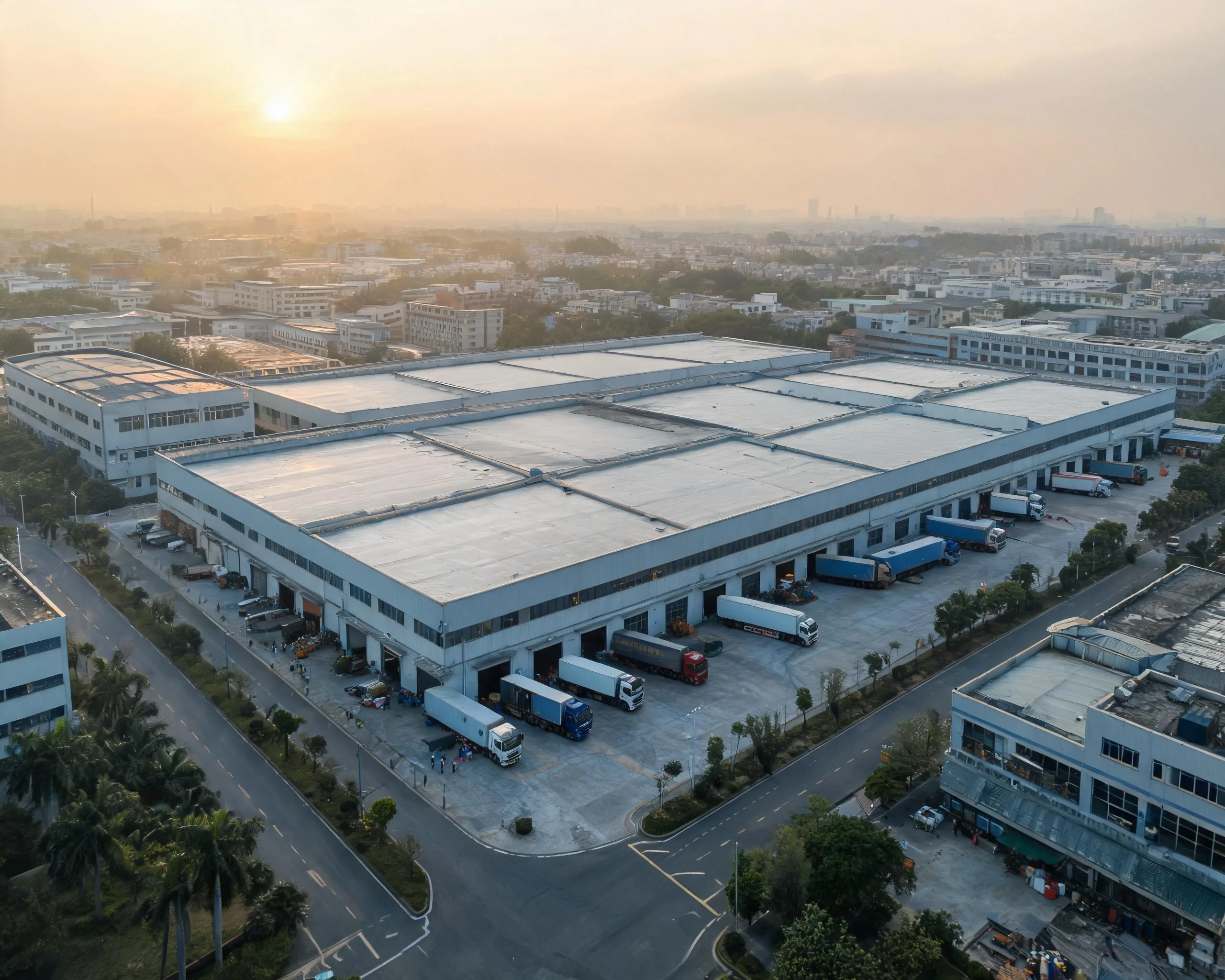
| Dimension | Direct Factory | Trading Company |
|---|---|---|
| Base Price | 100% | 112-120% |
| MOQ Requirement | 50-100 units | 10-30 units |
| Sample Lead Time | 25-30 days | 10-15 days |
| QC Responsibility | Factory internal team | Third-party or none |
| Communication | 8-hour timezone gap | Same timezone, native English |
| Change Response | 3-5 business days | 24-48 hours |
The 17% average markup isn't pure profit. Some goes toward legitimate services that solve real problems for small buyers. The mistake most importers make is paying for services they don't need, or paying 20% for something the factory would have done for free.
What the 17% actually covers
Trading companies justify their markup with six cost centers. Whether these are worth paying for depends entirely on your order size:
1. Order consolidation fee (3-5%): Trading companies combine small orders from multiple factories into a single container. If you're ordering 10 different SKUs from 5 suppliers, this saves you massive logistics headaches. If you're ordering one full container from a single source, you're paying for nothing.
2. MOQ buffer (2-4%): Factories won't run a production line for 20 units. Trading companies place bulk orders in advance and sell from their inventory. This is valuable for new businesses testing products — just understand you're paying a premium for flexibility.
3. Communication and project management (2-3%): Good trading companies employ native English speakers who understand Western business norms. They answer emails at 2 AM your time and chase the factory when deadlines slip. Bad ones just forward emails. There's no way to know which you're getting until it's too late.
4. QC and inspection (2-3%): Some trading companies do actual pre-shipment inspections. Most just ask the factory to send photos. Even the good ones charge extra, and you're still better off hiring your own third-party inspector who works for you.
5. Certification and document handling (1-2%): Trading companies prepare all export documentation, manage the certifications your target market requires, and handle customs clearance. This is actual work that takes expertise. It's also work any competent freight forwarder can do for $200 per shipment.
6. Risk absorption (3-5%): This is the big hidden value. When a factory messes up an order, trading companies sometimes absorb the cost to keep their client happy. They have ongoing relationships with multiple factories and can pressure them to redo work you could never get done as a one-off buyer. Our team has seen a good trading company eat a $12,000 rework cost rather than lose a high-value client. A factory would have told you "that's what you ordered" and ghosted you.
When paying the 17% is actually worth it
Let us be clear: trading companies are not always the bad guy. There are three specific scenarios where our team still recommends buyers use them:
1. Order value under $15,000: The administrative cost of dealing directly with a factory doesn't make sense for small orders. You'll spend 20 hours chasing communications that a trading company would handle in 1 hour. Your time is worth more than the $2,000 you'd save.
2. First order from a new product category: When you're testing something completely new and don't know the specs or common defects, a good trading company acts as your boots on the ground. They'll catch obvious mistakes you wouldn't know to look for. Once you've placed 2-3 orders and understand the product, cut them out and go direct.
3. Complex multi-factory projects: If you're furnishing an entire resort with 12 different product types from 8 factories, the coordination work is real. Someone needs to align production schedules and consolidate shipments. That's worth 10-12% right there — just don't pay 20% for it.
For orders over $50,000 from a single product category, you are actively leaving money on the table if you're not working directly with the factory. The 17% markup on a $100,000 order is $17,000 — enough to cover multiple plane tickets, third-party inspections, and a dedicated project manager.
How to tell a real factory from a fake one online
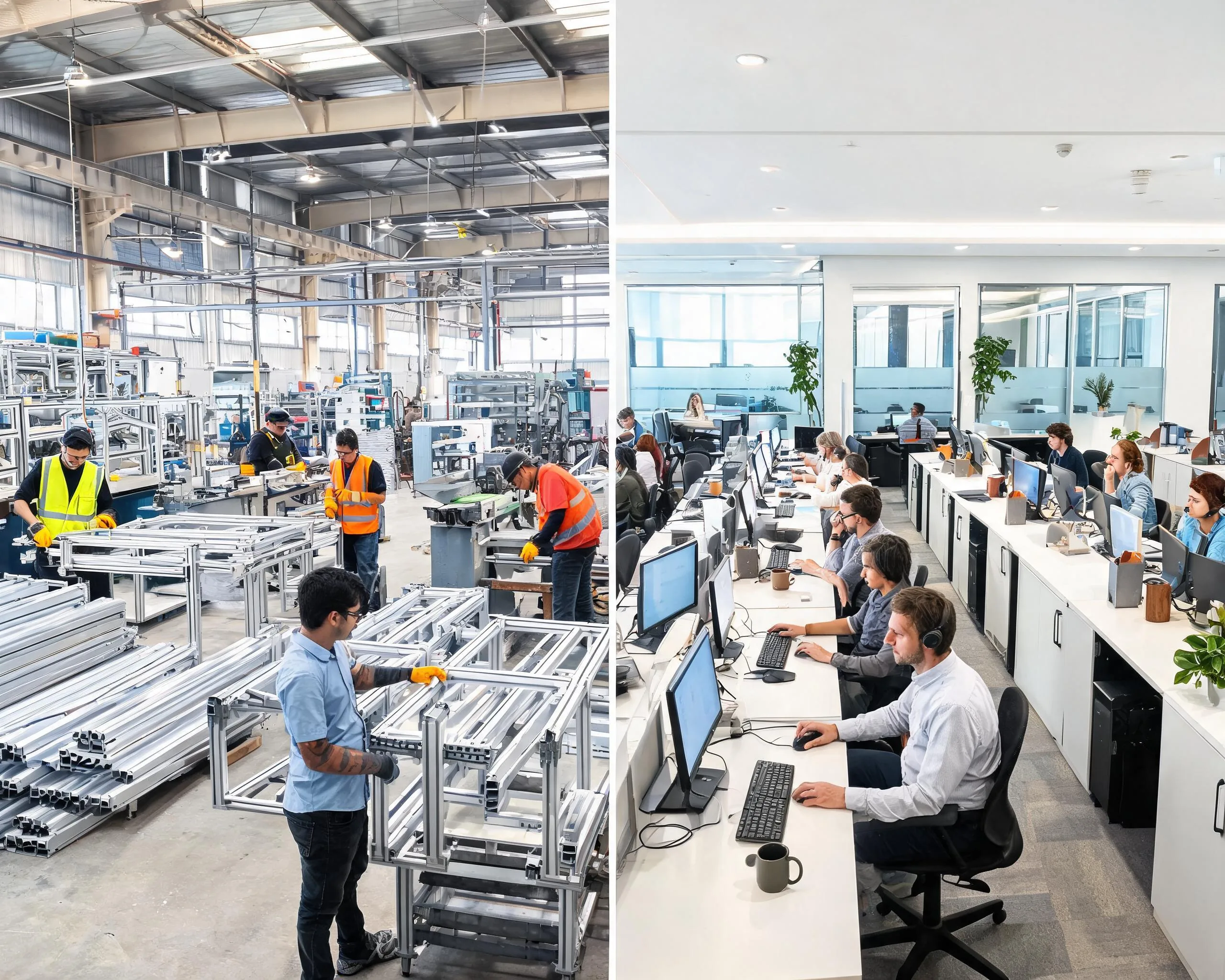
This is the 12-point checklist our team runs on every potential partner factory. It's caught 37 fake factories so far, including 3 that had premium status on major B2B platforms:
1. Check the company name for red flags: If the legal name includes "Trading," "International," "Commercial," "Import Export," or "Business," it's a trading company. If it's "Furniture Co., Ltd.," "Manufacturing Co., Ltd.," or "Industrial Co., Ltd.," keep going — they could still be faking.
2. Verify the platform badge type: "Verified Supplier" means the platform checked their business license exists. "Gold Supplier" means they paid money. Neither means they own a factory. Only "Onsite Checked" means someone visited the facility — and even that can be faked by renting space for the day.
3. Demand a live factory video call right now: Tell them you want to video call immediately, no scheduling. Ask them to walk to the production line, show you the machines running, and hold up a piece of paper with today's date. Trading companies will make excuses. Real factories say "sure, give us 5 minutes."
4. Scrutinize the quotation line items: Real factories quote with HS codes, exact material specs, component-level pricing, and separate breakdowns. Trading companies give you a single lump sum per unit with no details. Ask for the aluminum wall thickness, PE rattan denier count, foam density. If they can't answer immediately, they don't own the production.
5. Check the email domain and website: Generic platform emails are 99% trading companies. Company domains are necessary but not sufficient — anyone can register a website. Check the contact page: if it only shows an office address with no factory address, that's a red flag. If the "about us" page has suit photos but no production equipment, run.
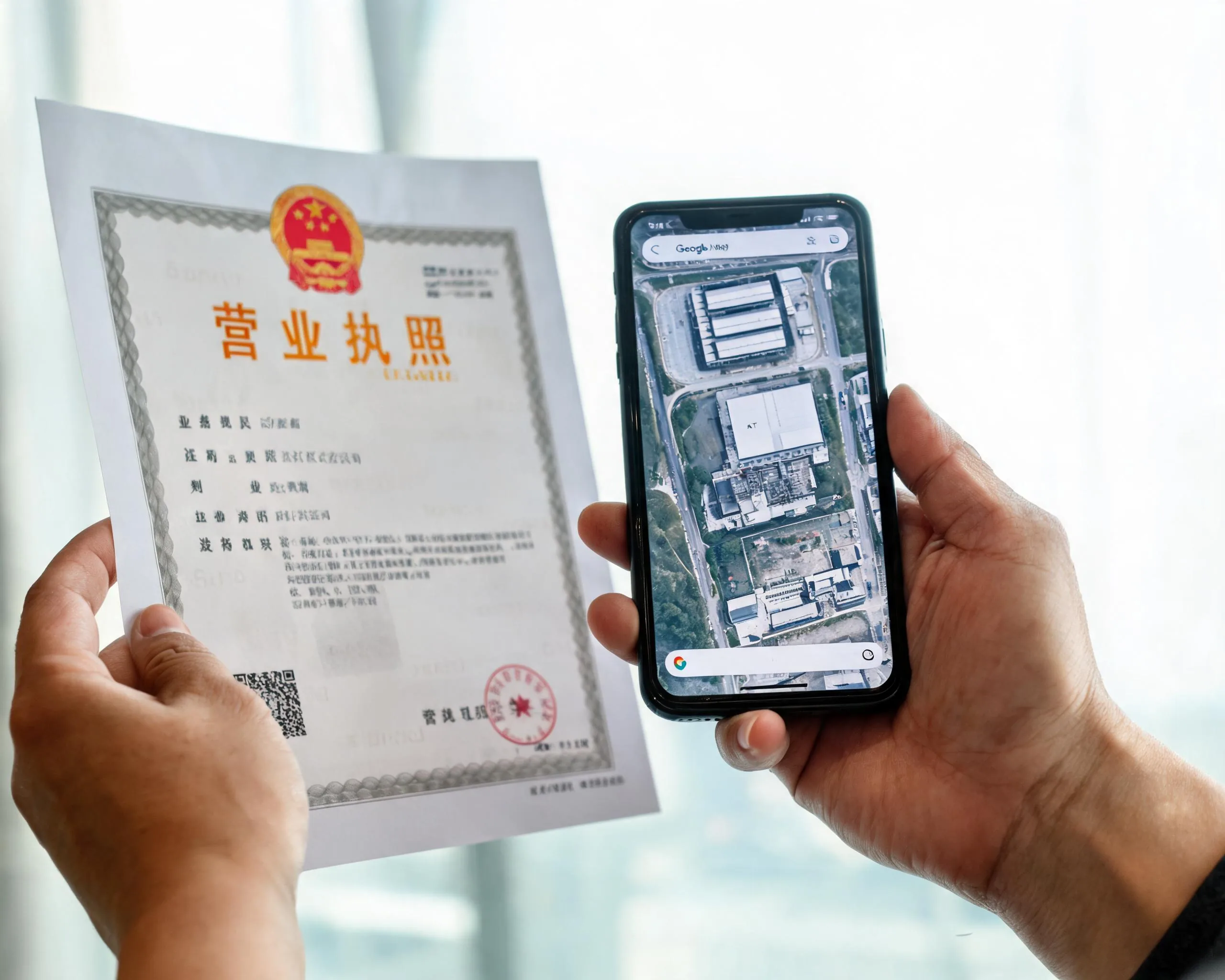
6. Look up the factory address on Google Maps Street View: Type the address into Google Maps. If Street View shows an office building downtown, that's not a factory. If it shows an industrial park with warehouse buildings and loading docks, you're heading in the right direction. Bonus: check if the building matches their website photos.
7. Trace compliance documents back to the issuing body: Any supplier can send you a PDF of the compliance documents your import broker will ask for. Ask for the certificate number, look up the issuing lab, and verify which company it was actually issued to. 40% of the time, the certificate belongs to a completely different factory.
8. Ask for a full BOM (Bill of Materials): Real factories maintain detailed BOMs for every product. They can tell you exactly how many kilograms of aluminum are in each frame, how many meters of rattan go into each chair, where each component is sourced. Trading companies don't have this information and will say "that's confidential."
9. Request three client references you can actually call: Don't accept testimonials on the website. Ask for the name, company, and phone number of three Western clients who placed similar-sized orders in the last 6 months. Call them. Ask specifically: "Did you visit the factory? Did you deal directly with the production team?" Most people will be honest.
10. Check EXIF data on factory photos: Ask them to email you 5 original, unedited photos of their production floor. Download them and check the EXIF metadata for date taken, camera model, and GPS coordinates if available. We once caught a trading company using 2017 stock photos from a factory 300km away.
11. Verify the payment account matches the contract company: Tell them you'll be wiring payment to the company name on the contract. Trading companies will ask you to pay to a different entity, usually a Hong Kong holding company or personal account. Real factories want payment to go to their actual operating company account — that's how they get export tax rebates. If the beneficiary name doesn't match 100%, walk away.
12. Just show up (or pay someone to): The ultimate verification is being there in person. If you're placing an order over $50,000, a $1,500 plane ticket to Guangzhou is cheap insurance. If you can't go yourself, hire a third-party auditing company for $300-500 to walk the production floor and verify the equipment is real and running.
None of these checks are foolproof on their own. A determined trading company can fake any single one. But they can't fake all 12. If a supplier passes every check, you're almost certainly dealing with a real factory.
Where buyers actually get burned: three industry observations our team has documented
The disappearing middleman
A US import team we met at a 2024 trade show placed a $38,000 order through a trading company they found online. They paid the 30% deposit, received production photos, got the bill of lading, and wired the balance. The container arrived with 200 used motorcycle tires instead of dining chairs.
The trading company had forged the bill of lading. The phone number was disconnected. The email bounced. The factory in Zhejiang had never heard of them. This wouldn't have happened with a real factory. Factories have physical addresses and equipment you can lien. Trading companies have Gmail accounts and a desire to disappear.
The hidden rework cost
One procurement lead from a Middle East resort chain shared with our team about a large order for resort lounge chairs they placed through a trading company. The quoted price was 18% higher than the factory direct price they found later, but their English was perfect and they promised 7-day samples. They didn't ask for the factory name.
The order arrived, and 30% of the chairs had peeling powder coating. The trading company blamed the factory. The factory said they'd built exactly what was specified. Neither side took responsibility. They ended up paying thousands to have the chairs refinished locally — on top of the 18% markup.
That's why at SOLAIREVA we always recommend writing the actual factory name into every contract, with explicit provisions that the factory is the manufacturer of record and has joint liability for defects.
The factory that was actually three factories
A resort project buyer we work with ordered $200K+ through a supposed manufacturer that turned out to be sourcing from three different factories across Guangdong. They didn't find out until the products arrived and the color difference between dining sets and lounge chairs was visible from 50 meters away.
Each factory had used a different powder coating supplier. The trading company never did incoming QC to match colors. They just put everything in the same container and shipped it. The rework cost was substantial, and the resort opening was delayed by 6 weeks. When they tried to claim compensation, the trading company pointed to a clause saying color variation up to 15% is acceptable.
None of this is unique to trading companies. Factories mess up too. The difference is that when you work directly with a factory, you know who is responsible. You can show up at their door. You have leverage. With a trading company, you're always one step removed from the actual problem.
The decision framework our team recommends before wiring any deposit
After 20+ years of outdoor furniture manufacturing in Shunde, Guangdong and 3 years of direct export, this is the decision tree we walk every client through:
If your order is under $15,000, use a trading company. The time you'll save on coordination is worth every dollar of the markup. Just check references, ask for factory names, and don't pay more than 15% premium.
If your order is between $15,000 and $50,000, do both. Use a trading company for the first order to test the product, then identify the actual factory and go direct for reorders. Most trading companies accidentally leak the factory name at some point — write it down.
If your order is over $50,000, go direct to the factory. No exceptions. Fly to China, visit the facility, meet the production manager. That relationship will save you more money over the next 5 years than any other sourcing decision.
Never work exclusively with a single source, whether factory or trading company. Always have a backup supplier you've tested with small orders. Chinese factories close suddenly. Trading companies disappear overnight.
Before you send any money over $10,000, get on a video call with someone physically standing on the production floor. Not in an office. Not in a showroom. On the actual production floor with machines running. We recommend this every single time — it takes 5 minutes and has saved our clients hundreds of thousands of dollars.
Learn how we verify a Chinese outdoor furniture factory before sending money — it's the same audit process we use for all our partner factories.