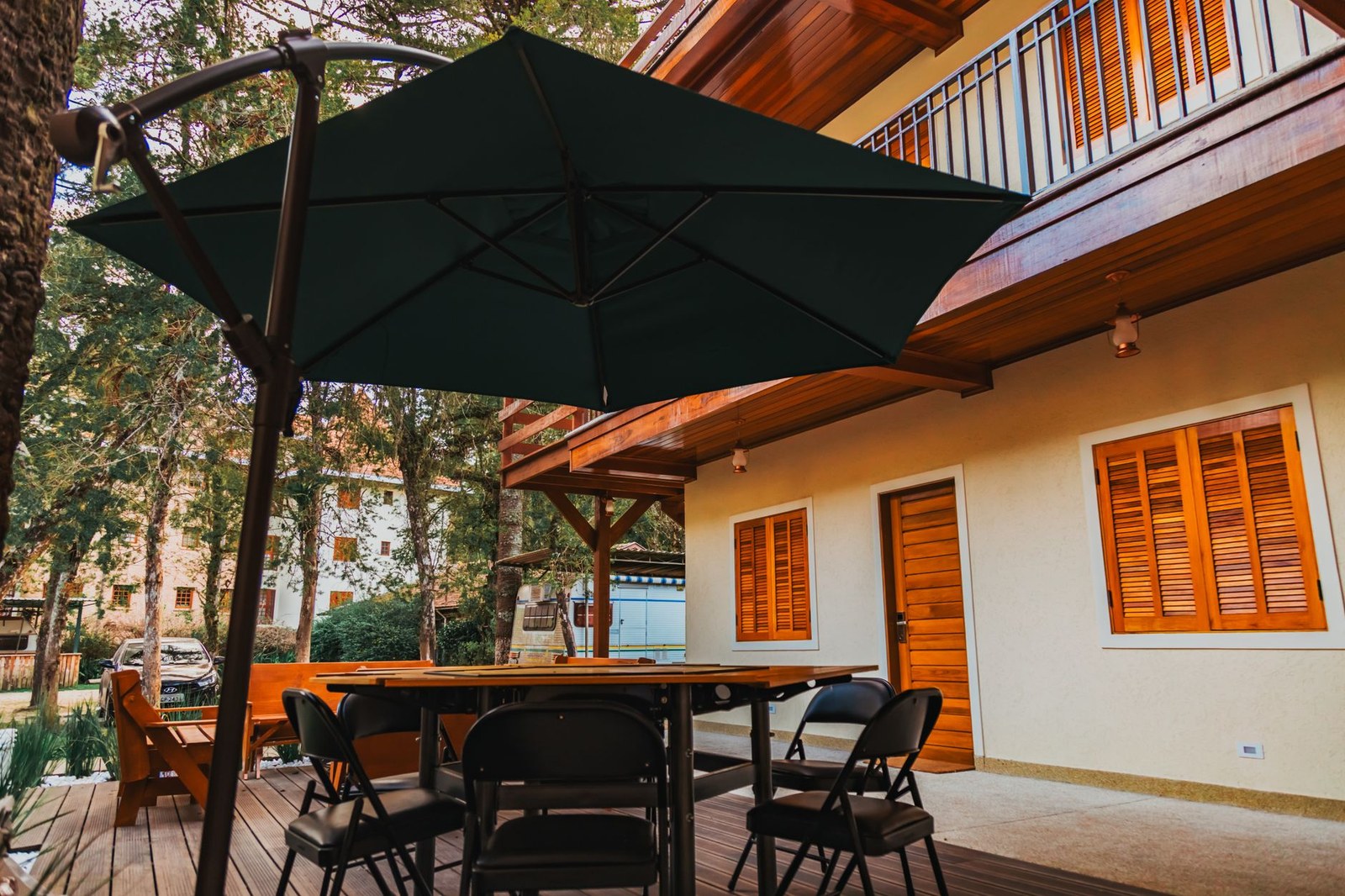
What a commercial patio umbrella order specifies
A commercial patio umbrella order is specified by canopy diameter, canopy fabric weight, pole section, base weight and the wind speed the unit has to survive. Hotel and restaurant buyers in 2026 choose between 2.5 m, 2.7 m, 3.0 m and 3.5 m canopies, 180 to 320 g/m2 fabric, poles from 48 mm round to 53 x 77 mm oval, and bases from 20 kg to 150 kg. Those five numbers decide whether the shade survives three summers or ends up stacked in a store room after one storm.
Retail umbrellas are built for a garden that gets used on weekends. A restaurant terrace runs ten to fourteen hours a day, seven days a week, and staff open and close the canopies far more often than a homeowner ever will. That changes the hub, the rib hinges, the fabric coating and the base. It also changes the question buyers ask: not which umbrella looks best in a catalogue photograph, but which one can be re-covered in year three without replacing the frame.
The table below is the specification sheet we work through on a first enquiry, with the retail default next to the contract requirement.
| Specification line | Retail default | Contract requirement |
|---|---|---|
| Canopy fabric | 160-180 g/m2 polyester | 240-320 g/m2 solution-dyed acrylic or 200-250 g/m2 coated polyester |
| Pole | 38-42 mm aluminium, 1.0-1.2 mm wall | 48 mm round or 53 x 77 mm oval, 1.5-2.0 mm wall, 6063-T5 |
| Ribs | 8 ribs at 10 x 18 mm | 8 ribs at 12 x 18 mm or 14 x 24 mm, replaceable |
| Powder coat | 40-50 micron | 60-80 micron outdoor polyester, 500+ hours salt spray |
| Base | 15-20 kg plate | 25-60 kg centre pole, 60-150 kg cantilever, or bolt-down plate |
| Spare parts | None | Ribs, hubs, cranks and canopy covers available for 5 years |
Canopy fabric: solution-dyed acrylic, polyester and olefin
Canopy fabric decides how the umbrella looks in year three. Solution-dyed acrylic at 280 to 320 g/m2 holds lightfastness grade 6 to 7 after 1,000 hours of ISO 105-B02 testing and costs 40 to 70 percent more than polyester at the same diameter. Polyester at 180 to 220 g/m2 usually starts at grade 4 and shows visible fade within two summers on a Dubai, Florida or Queensland terrace. We quote both fabrics, and the choice normally follows the replacement cycle the buyer can defend to an owner.
Solution-dyed means the pigment goes into the fibre before extrusion, so the colour sits through the yarn rather than on it. Surface-dyed and printed polyester keeps its colour in a thin layer that sunlight and cleaning wear through. Olefin sits between the two on price, resists water and chemicals well, and tends to lose colour faster than acrylic under strong UV.
Weight matters as much as chemistry. A 180 g/m2 canopy moves more in a breeze and stretches at the seams; 280 g/m2 holds tension, blocks more light and photographs better, but adds cost and a little freight weight. The backside coating is the other half of the story: a PU or PVC coating at 20 to 40 g/m2 keeps out rain for a few hours, which is what most terrace buyers need. Claims of full waterproofing belong to closed structures, not to a canopy with eight open sides.
| Fabric | Weight | Lightfastness (ISO 105-B02) | Expected service life | Price effect at 3 m |
|---|---|---|---|---|
| Polyester, surface dyed | 180-220 g/m2 | Grade 4 to 5 | 2-3 summers in high UV | Base price |
| Polyester, PU coated | 200-250 g/m2 | Grade 4 to 5 | 2-4 summers | +10-20% |
| Olefin | 200-240 g/m2 | Grade 5 to 6 | 3-5 summers | +20-35% |
| Solution-dyed acrylic | 280-320 g/m2 | Grade 6 to 7 | 5-8 summers | +40-70% |
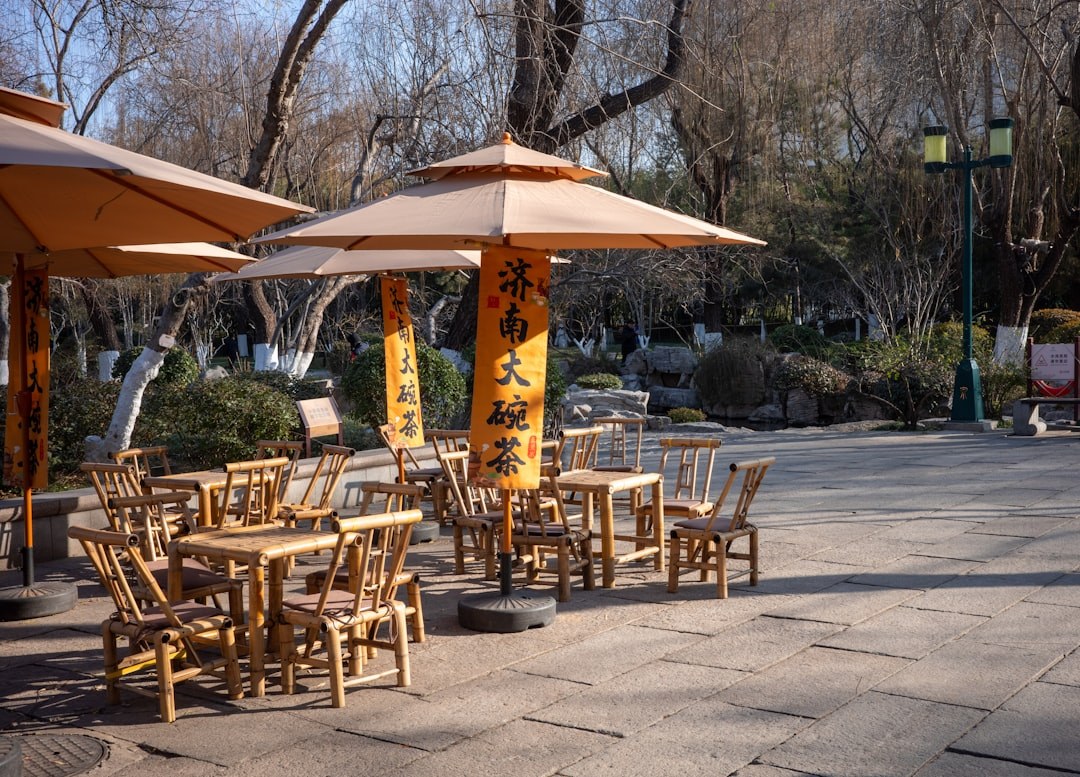
How much terrace one canopy covers
A 3.0 m octagonal canopy covers 6.4 m2 and shades one four-seat dining table with 60 cm of chair pull-out on each side. A 2.5 m canopy covers 4.4 m2 and suits two-top cafe tables, while a 2.7 m canopy at 5.2 m2 fits the gap between the two. Plan one umbrella for every 2.5 to 3.5 m of terrace grid, then walk the terrace at 3 p.m. rather than at noon, because midday shade tells you very little about the afternoon.
The shade moves. A canopy on a straight pole shades a circle that drifts east to west through the day, so a table that sits in shade at lunch can be in full sun by four o'clock. Cantilever umbrellas solve that with a rotatable canopy, at the cost of a heavier base and more deck space behind the seating. Valances add 20 to 25 cm of drop and help low sun, and side panels turn a canopy into a windbreak as well as shade.
For food and beverage planning, the working number is 1.5 to 1.8 m2 of shaded floor per seat. That places four seats under a 3.0 m canopy, six seats under a 3.5 m canopy and two seats under a 2.5 m canopy. Buyers who plan by table count rather than by shade area usually end up with a terrace that loses half its covers when the sun moves off the poles.
| Canopy diameter | Shade area | Typical seating shaded | Terrace grid spacing |
|---|---|---|---|
| 2.5 m | 4.4 m2 | 2 seats | 2.5-2.8 m |
| 2.7 m | 5.2 m2 | 2-4 seats | 2.8-3.0 m |
| 3.0 m | 6.4 m2 | 4 seats | 3.0-3.5 m |
| 3.5 m | 8.7 m2 | 6 seats | 3.5-4.0 m |
| 4.0 m | 11.3 m2 | 8 seats | 4.0-4.5 m |
Wind rating and base weight are two different numbers
Most commercial patio umbrellas are sold to stay open in Beaufort 4 to 5, which is 20 to 38 km/h, and should be closed once gusts pass 40 km/h. The base does not raise that rating. A 3.0 m canopy carries 6.4 m2 of sail, so a 30 kg base carries 4.7 kg of base per square metre of canopy while a 100 kg base carries 15.7 kg. What decides whether the umbrella is still standing in September is the anchoring, the exposure of the site and an operating rule the staff actually follows.
Exposure is site-specific and easy to underestimate. A courtyard between two buildings can funnel wind at twice the forecast speed. A rooftop or beach deck has no shelter at all. A pool deck has both wind and wet feet, so the base cannot simply be heavier and hope for the best: it also has to be stable on a wet tile and not become a trip hazard when staff move it for cleaning.
Three rules cover most projects. Close the canopies at night and whenever the terrace is empty, so an overnight gust finds a folded canopy with a fraction of the sail area. Use bolt-down plates or a fixed table-and-base combination anywhere the umbrella stays in place year round. Remove canopies entirely before a named storm or typhoon season, which is also the moment to inspect ribs and hubs.
| Canopy | Sheltered courtyard | Exposed terrace | Coastal or rooftop |
|---|---|---|---|
| 2.5 m centre pole | 20-25 kg | 30-40 kg | 40-60 kg or bolt-down |
| 3.0 m centre pole | 30-40 kg | 50-60 kg | 60-90 kg or bolt-down |
| 3.0 m cantilever | 60-80 kg | 90-120 kg | 120-150 kg, fixed plate |
| 4.0 m cantilever | 100-120 kg | 150 kg and above | Engineered fixing, not a loose base |
Centre pole, cantilever or side mast
Centre-pole umbrellas suit a dining table with a 40 to 50 mm hole and run USD 30 to 95 FOB at 3 m depending on fabric. Cantilever umbrellas clear the table completely and run USD 120 to 260 at 3 x 3 m with a 60 kg base. Choose by the furniture and the deck, not by the picture: a centre pole needs a table with a suitable hole and a base that does not catch guests' feet, while a cantilever needs 60 to 90 cm of clear space behind the seating for the mast and the rotation arc.
The centre pole is the cheaper and simpler system, and it works well where tables stay in place. Its weakness is the hole in the table top, which collects water and limits table design, and the base under the table, which every guest at the far end has to step around. For a restaurant that resets the terrace twice a day, that base is also the part staff trip over. This is why most restaurant parasol orders we quote end up as centre-pole units for fixed tables and cantilever units for the loose seating along the edge.
A cantilever puts the weight outside the seating area and lets one canopy rotate over two or three tables through the afternoon. The cost is a heavier base, a bigger carton, and a mast that has to be positioned so the arms do not foul a wall or a planter. On narrow balconies and tight roof terraces, a side-mast or wall-mounted arm is often the only system that fits, and it has to be engineered into the building rather than bought as a loose item.
| Venue | System | Why |
|---|---|---|
| Restaurant terrace with fixed tables | Centre pole through table | Cheapest shade per seat, base hidden under the table top |
| Pool deck with loose loungers | Cantilever, rotatable | No pole between loungers, shade can follow the sun |
| Long communal table | Twin or triple canopy | One mast, continuous shade over 4 to 6 m of table |
| Narrow balcony or rooftop edge | Side mast or wall arm | No floor footprint, needs structural fixing |
| Beach club with movable seating | Cantilever on a heavy mobile base | Reconfigurable by staff, stable on sand or decking |
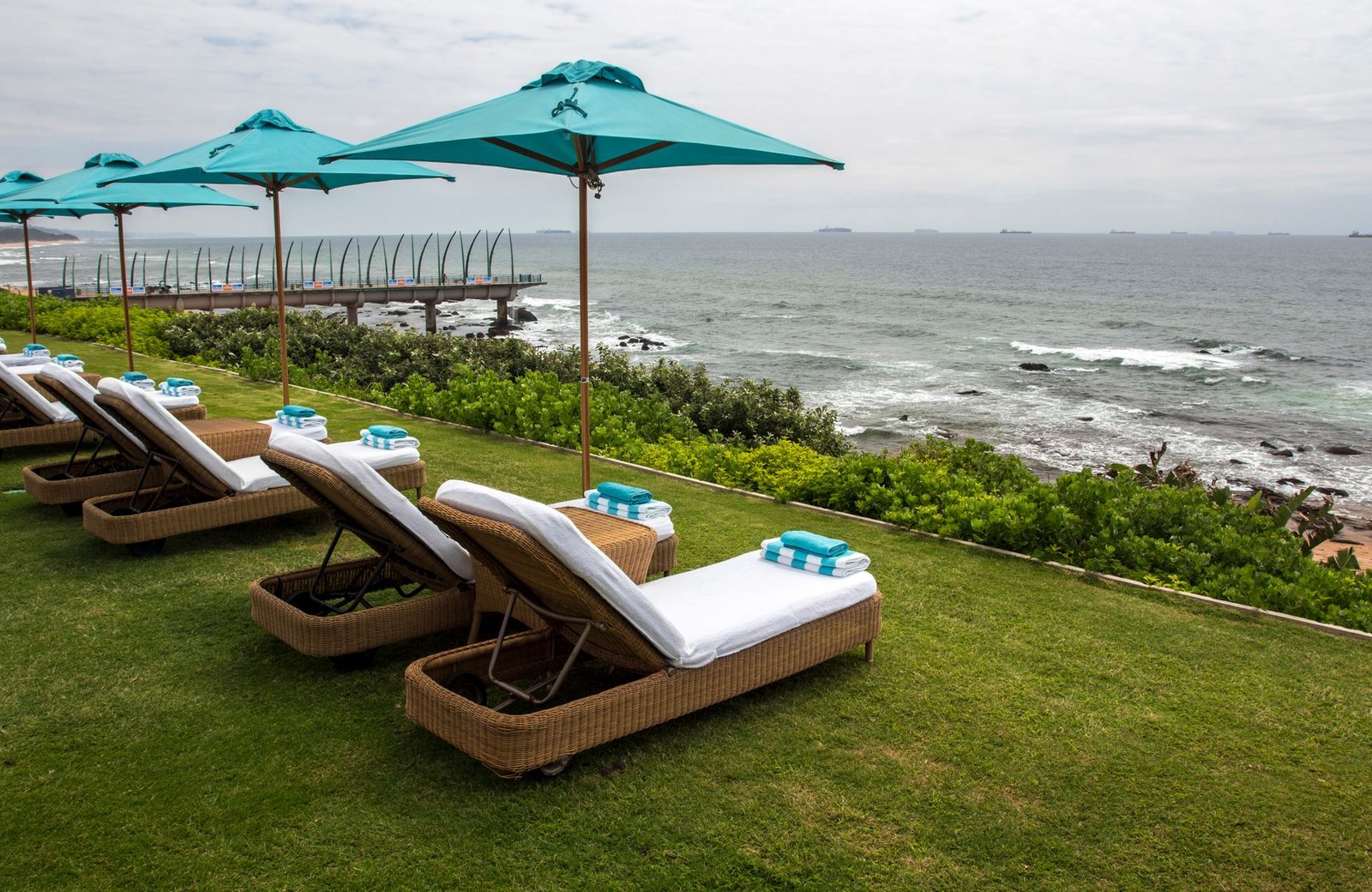
Frames, ribs and the powder coat that sets the service life
Frame numbers show up on a spec sheet and on a cut sample: 6063-T5 aluminium at 1.5 to 2.0 mm wall, a 48 mm round pole for a 2.7 m canopy, a 53 x 77 mm oval pole for a 3 m cantilever, ribs at 12 x 18 mm or 14 x 24 mm, and 60 to 80 micron of outdoor polyester powder coat. A 1.2 mm pole with a 40 micron coat is where the two-season umbrella comes from, and the failures usually appear first at the hub and the rib hinges.
Hubs take the load on every open and close. Glass-filled nylon hubs are normal on 2.5 to 3.0 m canopies and work well when the moulding is thick and the rivets are stainless. Steel hubs last longer on 4 m cantilevers but need proper coating or they bleed rust onto the canopy within a season. Check the rivet material too: plain steel rivets in an aluminium frame are the fastest route to a wobbling rib.
Fasteners and small hardware decide how the umbrella ages at the coast. Grade 304 stainless is adequate 5 km inland; grade 316 is the safer choice within 1 km of salt water. Ask for the salt spray report by name, with hours reached and the laboratory on it. We test powder-coated frames to ASTM B117 through a third-party laboratory, and a 1,000-hour result is a very different product from a 240-hour one, even when both frames look identical in a photograph.
Bases, plates and fixing into the deck
Base choice is a fixing decision before it is a weight decision. A 20 kg plate suits a 2.7 m umbrella in a sheltered courtyard, 60 kg is the working minimum for a 3 m cantilever on a restaurant terrace, and 100 to 150 kg or a bolt-down plate is what exposed coastal decks need. Loose pavers, composite decking and raised terraces often cannot take a bolt-down plate at all, so the base has to carry the load instead, which changes freight cost and the staff's daily setup.
Water-fillable and sand-fillable bases are popular because they ship light and get heavy on site. They are also the base type most often under-filled: a 60 kg water base filled to 40 percent is a 24 kg base holding a 6.4 m2 sail. If a project uses fillable bases, write the fill instruction into the handover document and make one person responsible for checking it before the season opens.
| Base type | Weight on site | Fixing | Suited site |
|---|---|---|---|
| Cast plate, 20-30 kg | 20-30 kg | Loose, under table | Sheltered courtyard, 2.5-2.7 m canopy |
| Cast or granite plate, 50-60 kg | 50-60 kg | Loose with 2-4 paver weights | Restaurant terrace, 3 m canopy |
| Cross base with weights, 60-100 kg | 60-100 kg | Loose, wide footprint | Cantilever on composite decking |
| Bolt-down plate | 15-25 kg plate | 4 x M10 into structure | Rooftop, coastal deck, permanent installation |
| In-ground sleeve | None above ground | Concrete footing | Beach club, pool surround |
Canopy branding and colour matching
Canopy branding is the cheapest visible customisation on a terrace and one of the slowest to produce. A one-colour logo print adds USD 2 to 6 per canopy at 100 pieces or more, full-colour digital print runs USD 8 to 18, and a new canopy colour dyed to a Pantone reference adds 7 to 12 days because the fabric is dyed to order. Buyers who need 40 umbrellas for one opening usually keep the frame standard and print the canopy instead of changing the fabric colour.
Print method matters for how long the logo lasts. Screen print with a UV-stable ink on acrylic holds up well for three or four seasons. Digital transfer sits on the surface and can crack where the canopy folds, so it suits short campaigns better than permanent branding. Woven labels and appliqué cost more and last the life of the canopy, which is what hotel groups with a fixed brand standard tend to choose. Most custom logo patio umbrellas we quote are one or two colours on a standard canopy, because that combination keeps the minimum low and the lead time short.
Matching the canopy to the frame, the cushions and the building facade is a dye lot question as much as a colour question. One dye lot should cover the whole project, and a second phase ordered a year later needs a lab dip against the retained sample. Our custom colour matching guide covers the powder coat side of the same process, with the RAL and Pantone handling we use on frame and fabric together.
MOQ, samples and lead times from a China umbrella factory
MOQ on catalogue umbrellas starts at 50 to 100 units per colour and model, or 20 to 30 sets for cantilever frames sold with bases. A custom canopy print moves the minimum to 100 to 200 pieces because the fabric run is set up per design. Samples take 7 to 15 days on a catalogue frame and 20 to 30 days with new canopy printing, and bulk production runs 20 to 45 days after deposit confirmation, longer in the August to October peak ahead of the European and North American season.
Mixed orders are how smaller buyers reach a sensible freight position. Four to six models can share one production slot, so a first order of 150 to 300 umbrellas across two or three canopy colours is realistic for a 60-cover terrace without paying a small-order surcharge on every line. If bases ship in the same container, plan the weight before the volume: bases are dense and can use up the 26 to 28 t payload long before the container looks full.
On samples, ask for the production frame rather than a display sample, and keep it as the reference for the bulk run. Check the pole wall with a caliper, weigh the canopy, and open and close the umbrella 20 times to see whether the hub binds. A sample that arrives perfect but differs from the bulk order is the most common complaint we hear from buyers who sourced elsewhere first.
FOB prices and landed cost in 2026
A 3 m centre-pole umbrella in 180 g/m2 polyester runs USD 30 to 60 FOB, the same frame in 280 g/m2 solution-dyed acrylic runs USD 55 to 95, and a 3 x 3 m aluminium cantilever with a 60 kg base runs USD 120 to 260. Ocean freight at USD 2,300 to 3,400 per 40HQ plus duty and inland delivery puts landed cost at roughly 1.8 to 2.2 times FOB. A USD 60 umbrella therefore lands at USD 108 to 132 before installation and before any site fixing.
Duty depends on the tariff line and the destination. Umbrellas classified under HS 6601.10 usually carry around 4.7 percent in the EU and the UK and around 8.5 percent in the United States, and a broker should confirm the code against the actual product before the order is priced. The shipping cost guide breaks the freight and port charges down per container, and the total cost of ownership guide carries the same numbers across a five-year replacement cycle.
| Product | 2026 FOB band | What moves the price |
|---|---|---|
| 2.5 m centre pole, polyester | USD 22-40 | Fabric weight, rib count, crank type |
| 3.0 m centre pole, polyester | USD 30-60 | Pole wall, hub material, valance |
| 3.0 m centre pole, acrylic | USD 55-95 | Fabric grade, print, wooden or aluminium pole |
| 3 x 3 m cantilever, aluminium | USD 120-260 | Rotation mechanism, base, fabric, LED option |
| 4 x 4 m cantilever, heavy duty | USD 320-620 | Frame section, base weight, twin canopy |
| Cast base, 20-60 kg | USD 12-75 | Material, finish, freight weight |
Container loading for umbrella orders
A 40HQ gives 65 to 70 m3 of usable volume. Centre-pole umbrellas packed at 150 x 15 x 15 cm take 0.034 m3 each, which puts a single-model container at 1,200 to 1,700 pieces once stacking, dunnage and empty corners are allowed for. Cantilever sets packed at 1.1 to 2.2 m3 load 30 to 60 sets. Mixed loads of frames, bases and canopies usually land near the lower figure because heavy bases cannot be stacked high.
The arithmetic is straightforward, but the weight limit catches people. A 40HQ carries about 26 to 28 t of cargo, so 400 cast bases at 50 kg arrive at 20 t before a single umbrella is loaded. That is why experienced buyers ship bases in the same container only when the base count is low, and otherwise buy plates locally or ask for a lighter cast design. Our container capacity calculator runs the volume and weight check on carton dimensions per SKU.
Care, spare parts and the warranty terms that decide year three
A commercial umbrella is judged in year three, when the canopy needs replacing and the frame either still holds tension or does not. Replacement covers cost USD 25 to 45 at 3 m, individual ribs USD 3 to 8, and a re-cover is normally far cheaper than a new umbrella if the frame and hub are sound. That is why warranty terms should be read line by line: 2 to 3 years on the frame and powder coat, 1 to 2 years against fabric defects, and storm damage excluded in almost every contract.
Fabric fade sits in a grey zone that catches hotels every season. Most factories cover manufacturing defects such as seam failure or coating delamination, and most exclude normal colour change under UV, which is exactly the failure a terrace sees first. A supplier that states a fade allowance in writing, for example grade 4 or better at 1,500 hours, gives the buyer something to hold. The warranty checklist lists the clauses worth putting in the purchase order.
Day-to-day care is simple and mostly ignored. Rinse canopies with fresh water every two to four weeks in coastal air, clean with a mild soap rather than a pressure washer, and let the canopy dry fully open before closing it for the season. Mildew on a folded canopy is a storage problem, not a fabric problem. Keep three to five percent of the order in spare ribs, hubs and cranks, because the parts that fail are cheap and the freight to replace them later is not.
Frequently asked questions about commercial patio umbrellas
These five answers cover what buyers ask most often before placing an umbrella order: minimum quantity, FOB price, wind limits, container capacity and fabric choice. Each answer stands on its own and can go straight into an enquiry or an internal approval note. The short version for a first terrace order is 50 to 100 units per colour in polyester or acrylic, 60 to 150 kg of base depending on exposure, and one 40HQ carrying 1,200 to 1,700 centre-pole umbrellas or 30 to 60 cantilever sets.
What is the MOQ for custom patio umbrellas from China?
MOQ is 50 to 100 units per colour and model on catalogue frames, 20 to 30 sets for cantilever umbrellas sold with bases, and 100 to 200 pieces where the canopy carries a custom print or a new dyed colour. Mixed orders across four to six models share one production slot, so a 150 to 300 piece first order is workable for a single venue.
How much does a commercial patio umbrella cost FOB in 2026?
A 3 m centre-pole umbrella in 180 g/m2 polyester is USD 30 to 60 FOB, the same frame in 280 g/m2 solution-dyed acrylic is USD 55 to 95, and a 3 x 3 m aluminium cantilever with a 60 kg base is USD 120 to 260. Landed cost typically lands at 1.8 to 2.2 times FOB once freight, duty and inland delivery are added.
What wind speed can a commercial patio umbrella handle?
Most commercial umbrellas are rated to stay open in Beaufort 4 to 5, which is 20 to 38 km/h, and should be closed once gusts exceed 40 km/h. Base weight does not raise the wind rating. Anchoring, site exposure and a written closing rule matter more, and canopies should come down before a named storm.
How many umbrellas fit in a 40HQ container?
Centre-pole umbrellas packed at 150 x 15 x 15 cm take 0.034 m3 each, so a single-model 40HQ carries 1,200 to 1,700 pieces. Cantilever sets at 1.1 to 2.2 m3 per set load 30 to 60 sets. Heavy bases usually hit the 26 to 28 t payload limit before the container is full, so bases are planned separately.
Should a hotel terrace use acrylic or polyester canopy fabric?
Solution-dyed acrylic at 280 to 320 g/m2 holds lightfastness grade 6 to 7 at 1,000 hours and lasts 5 to 8 summers, at 40 to 70 percent more than polyester. Polyester at 180 to 220 g/m2 lasts 2 to 3 summers in strong UV. For a terrace that stays open year round, acrylic is normally the cheaper choice per season of use, even at the higher first cost.
Commercial patio umbrellas from SOLAIREVA
SOLAIREVA has manufactured outdoor furniture in Shunde, Guangdong since 2004, with a 16,000 m2 factory, 49 team members and more than 15,000 pieces of monthly production across seating, dining, lounging and shade. Our shade range covers centre-pole, cantilever, twin and triple frames from 2.5 m to 4 m, with polyester and solution-dyed acrylic canopies, cast and bolt-down bases, and printed or dyed canopy options. We ship 15 or more high-cube containers a month to hotels, resorts and restaurant groups, with quarterly SGS salt spray testing and a 0.47 percent export defect rate across the four-stage QC line.
Typical terms: 50 to 100 units per colour on catalogue frames, samples in 7 to 15 days, production in 20 to 45 days, FOB Shenzhen or Nansha, carton dimensions and weights per SKU for your forwarder, and spare ribs, hubs and covers at 3 to 5 percent of the order. Canopy print files, Pantone references and base fixing details go into the same quotation so the terrace plan and the container plan are costed together. Start with the commercial shade umbrella, the 3 m centre-pole model or the cantilever range, or send your terrace plan and quantities through the quote request form. The restaurant terrace solution and solutions pages group the same products by venue type.