Why Worker Training Is a Quality Question, Not an HR Question
Worker training determines furniture quality before inspection ever happens, because most defects — uneven rattan weave, thin powder coat, misaligned frames — are created by hand at the workbench. SOLAIREVA's 16,000 m² Shunde factory runs 49 production workers through a structured 3-month onboarding program, and the pre-shipment defect rate comes out at 0.47% on inspected orders. A factory that hires casually and trains on the job will show it in batch-to-batch drift, no matter how good its final QC looks. When you evaluate a supplier, the workforce system is the first thing to examine, because it is the root cause that QC reports only measure at the end.
The 3-Month Training Program: From New Hire to Line-Ready
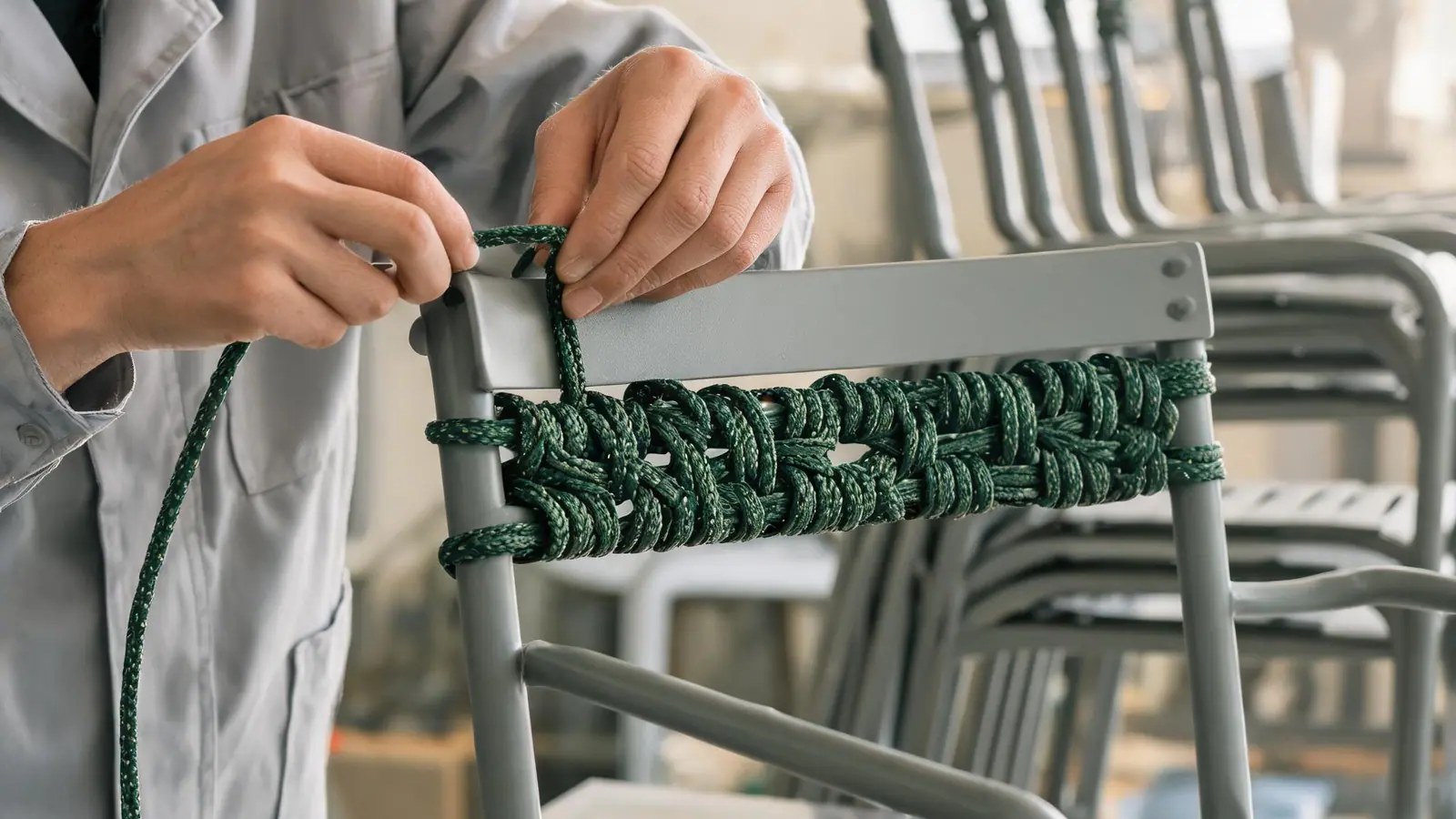
SOLAIREVA structures new-worker onboarding in three phases that take about 12 weeks, with a hands-on certification at the end before anyone works independently. The first 4 weeks cover material identification, tool handling, and safety: trainees learn to tell virgin HDPE rattan from recycled grades, 6063-T5 aluminum from softer alloys, and how to read a written bill of materials. Weeks 5-8 add supervised hand-weaving and frame work on real components, with a senior worker checking every piece. Weeks 9-12 move the trainee into normal line production while QC flags defects the same day and the trainer walks through the cause. Only after 10 consecutive defect-free pieces in a supervised assessment does the worker earn a skill card.
Week 1-4: Materials, tools, and the bill of materials
New hires start by learning exactly what they will be judged against: the specification on the work order. They practice identifying virgin versus recycled PE rattan, verify aluminum alloy labels, and learn the powder-coat thickness target for each product family. Safety training on weaving, welding, and coating equipment runs in parallel, because an unconfident worker produces slower and sloppier output. At the end of week 4, a written test on materials and work-order reading decides who moves to the bench. This phase is what most small workshops skip, and it is why their finished goods vary more between batches than ours do.
Week 5-8: Supervised weaving and frame assembly
Trainees now build real components, but every piece is checked against the approved sample by a senior worker or QC. When an error appears — a loose weave, a weld splash, a cushion seam off-line — the trainee reworks that piece immediately instead of moving on. This repetition is deliberate: the correct motion pattern gets practiced more than the mistake. Output speed is secondary during these weeks; consistency is the target. The senior worker logs each correction, and the QC team reviews the log weekly to spot which skill needs extra drills. By week 8, most trainees hold a steady weave density and straight frame alignment without constant correction.
Week 9-12: Line production with daily feedback
In the final phase, trainees work at normal production pace while their output is tracked per worker and reviewed daily against the line standard. QC records the defect type for every flagged piece — weave gap, coating flaw, assembly gap — and the trainer explains the cause the same day. Weekly reviews compare each trainee's defect count with the line average, and additional drills are assigned where the gap is widest. This phase is a real test because speed pressure returns; the skill-card assessment at the end requires 10 consecutive defect-free pieces under that pressure. Workers who pass consistently are the reason large orders do not degrade halfway through production.
Keeping 49 Workers at the Same Standard: The Skill-Maintenance System
Training does not end at certification; a skill-card system, monthly spot checks, and pay tied to defect outcomes keep 49 production workers aligned over years, not just the initial 3 months. Every month QC samples each worker's output, and any worker whose defect trend rises is assigned re-training before the next order, not after a complaint arrives — a loop that holds the 0.47% defect rate steady. Pay is partially linked to defect performance, so workers re-check their own weaving and welds before passing a piece to the next station. Senior weavers with the highest skill cards train new hires, which is why a 200-container year does not stretch quality thin during peak season.
The skill-card system and monthly spot checks
Every production worker holds a skill card that lists which operations they are certified for — hand weaving, frame welding, powder-coat touch-up, cushion fitting, final assembly. Monthly spot checks sample a fixed number of pieces per worker, and the results update the card. A worker who fails a spot check is moved to supervised re-training until the defect pattern clears, then re-assessed. The card also controls who may work on what: a custom order with tight tolerances is staffed only by workers certified for that operation. For buyers, the practical effect is that your order is never built by someone learning on your goods — the learning happens on scrap and test pieces first.
Pay structure that rewards defect-free output
Production pay at SOLAIREVA is a base rate plus a quality component tied to each worker's defect record, which changes behavior in a way that final inspection never can. A worker who delivers 100 pieces with no defects earns more per piece than one whose output needs rework, and the rework itself is done on the worker's own time. This creates a simple loop: checking your own work before passing it on becomes the fastest way to earn more. Combined with the monthly spot checks, the incentive system is the main reason the pre-shipment defect rate holds at 0.47% even when the factory ships 200-plus containers a year. Incentives, not slogans, are what keep craftsmanship consistent.
Batch-to-Batch Consistency: The Systems Behind Craftsmanship
Consistent craftsmanship across batches and reorders comes from archived references plus written specifications, not from worker memory. SOLAIREVA stores a production sample of every order for 5 years, keeps the written bill of materials on file, and matches colors to a delta-E standard below 2.0 before a reorder starts. The same 4-stage QC system — incoming material, in-production, pre-shipment, and packing — runs on every batch regardless of order size. When a reorder arrives, workers are shown the archived sample and the line sign-off sheet from the original run. That is how a 45-55 day lead time can still hold finish tolerances on repeat programs.
Sample archiving and the written bill of materials
Every order's approved sample is tagged, photographed, and stored in a dedicated archive that goes back 5 years. The written bill of materials — frame alloy, coating system, fabric brand and grade, foam density, packaging spec — lives in the order file next to it. When a reorder comes in, production compares the new batch against the archived sample, not against a description in an email. For custom OEM programs, this archive is what makes your second order match your first, which is the difference between a one-time supplier and a repeat manufacturing partner. You can see how this connects to the wider OEM process from design to delivery in our step-by-step guide.
Color and finish matching on reorders
Color drift is the most common reorder complaint in outdoor furniture, and it is prevented before production, not fixed after. SOLAIREVA measures custom powder-coat and rattan colors against the archived standard using a delta-E measurement below 2.0 — a tolerance tighter than the human eye can reliably distinguish. If the incoming coating batch fails the measurement, it is rejected before a single frame is sprayed. The same standard applies to fabric and cushion colors. For branded programs where a resort's terrace must match last season's delivery, this gate alone prevents most visible mismatches. Details on how finishes are matched and specified live in our private label branding guide.
How Training Shows Up in QC, Lead Time, and Warranty
A trained workforce changes the numbers a buyer actually cares about: defect rate, lead time, and warranty claims. SOLAIREVA's 0.47% pre-shipment defect rate is measured across the 4-stage QC system, and the 45-55 day lead time on standard orders is stable partly because workers do not need re-training mid-order. Fewer defects at packing mean fewer replacements shipped, which is why the commercial warranty terms stay workable for the factory and the buyer. The OEM quality control checkpoints guide explains each inspection gate, and our Shunde factory overview shows the production setup behind these numbers. If you want the full picture of how training, QC, and warranty interact, the warranty coverage guide breaks it down component by component.

Questions to Ask Any Factory About Its Workforce
Buyers can verify workforce quality without visiting the plant by asking four questions and comparing answers to hard numbers: onboarding length, certification method, per-worker defect tracking, and the defect rate on third-party inspection over the last 12 months. A factory with a real system answers with specifics — 3 months of training, a skill-card test, per-worker logs — while a casual workshop gives generalities. Then ask for a live video walkthrough of the production floor, and request the inspection report from your third-party agency or a recent SGS-style report. The full verification procedure, including documents to request, is covered in our factory verification guide and the factory audit checklist.
- How long is new-worker onboarding, and what is tested at the end? A structured answer with weeks and a certification step indicates a system; "we train on the job" means your order may be part of the training.
- How are defects tracked per worker, and what happens on a bad trend? Look for per-worker logs and re-training triggers, not just a final inspection pass rate.
- What is the defect rate on recent third-party inspections? Under 1% on inspected commercial orders is strong; 1.5-2.5% AQL is the common industry acceptance level, not a bragging point.
- Can I see a live video walkthrough of the production floor? A factory confident in its workforce says yes on the spot; hesitation is a signal worth probing before any deposit.
Frequently asked questions about factory worker training
How long does it take to train an outdoor furniture worker?
A commercial outdoor furniture worker typically needs a structured 3-month program before working independently on line production. At SOLAIREVA's Shunde factory, the first 4 weeks cover material identification and safety, weeks 5-8 add supervised hand-weaving and frame work on real components, and weeks 9-12 move the trainee into line production with daily QC feedback. A trainee only earns a skill card after passing a hands-on assessment on 10 consecutive defect-free pieces. Untrained or casually onboarded workers are the most common hidden cause of batch-to-batch quality drift on large orders.
Why does worker training affect furniture quality?
Training determines how consistently a worker reproduces a specification. A weaver who understands why virgin HDPE is required, how a 6063-T5 aluminum weld should look, and how to check a powder-coat thickness will catch problems at the workbench rather than in final inspection. SOLAIREVA links pay partly to defect outcomes, so workers re-check their own output before it moves to the next station. On a 16,000 m² floor with 49 production workers, that habit is what holds the pre-shipment defect rate at 0.47% while shipping 200-plus containers a year.
How do you keep quality consistent between batches and reorders?
Batch consistency comes from archived references plus written specs, not memory. SOLAIREVA stores a production sample of every order for 5 years, keeps the written bill of materials on file, and matches colors to a delta-E standard below 2.0 before a reorder starts. The same 4-stage QC system — incoming material, in-production, pre-shipment, and packing — runs on every batch regardless of order size. When a reorder arrives, workers are shown the archived sample and the line sign-off sheet from the original run, which is how a 45-55 day lead time can still hold finish tolerances on repeat programs.
What is SOLAIREVA's defect rate?
SOLAIREVA holds a pre-shipment defect rate of 0.47% on inspected commercial orders, achieved with a 4-stage QC system and a 49-worker production team in a 16,000 m² Shunde factory. The four gates are incoming material inspection, in-production checks, a pre-shipment inspection against the approved sample, and final packing verification. Every worker's output is tied to defect tracking, and third-party inspection is welcome at any stage. For context, an industry-acceptable pre-shipment level is often quoted around 1.5-2.5% AQL, so 0.47% sits well below the common acceptance threshold.
How can I verify a factory's workforce quality before ordering?
Ask for three things before you commit: a live video walkthrough of the production floor, the factory's training or onboarding process for new workers, and its defect rate on third-party inspection reports from the last 12 months. A factory that trains workers formally will usually show you the skill-card system and QC feedback loop without hesitation. Booking an independent SGS-style inspection before the production deposit costs a small fraction of a bad container. Treat vague answers about training or worker turnover as a risk signal, because workforce consistency is what actually delivers repeatable quality.
See the training system behind a 0.47% defect rate
SOLAIREVA quotes every project from a written bill of materials, with a 20-50 unit per-SKU MOQ, a 45-55 day lead time, and a pre-shipment defect rate of 0.47% across the 4-stage QC system. Our 16,000 m² Shunde factory has manufactured commercial-grade outdoor furniture since 2004, and the 49-worker production team behind those numbers is trained, certified, and audited on the system described in this guide. If you are evaluating factories, our numbers are open to verification: ask for the walkthrough, the skill-card system, and third-party inspection reports.
Next steps: Send your quantities, target products, and destination to request a specification-based quote, or explore our OEM and ODM options for custom sizes, colors, or branding. If you are still shortlisting suppliers, add these workforce questions to your audit — and ask us the same ones. You can also talk to our project team directly about how we staff and train for orders like yours.